Folder/Filename Convention

What is the Folder and filename convention for NAS/HDD/SDD?

My Folder name is a genre, mood, style,… (e.g., Rock, Bluegrass, New Age, Easy Listening, Relaxing, Dining, etc.)
---- My song filename is Artist - Song-Title.ext
---- If there are multiple artists then my filename is
Artist, Artist… + Artist - Song-Title.ext
---- My playlist filename is mood.ext

– What are the supported playlist file extensions?
– Can a video playlist be created? If so, elaborate on file convention
– What is the folder/filename convention for gapless playback?
– Can user specify art cover for a particular song/album/playlist? If so, what is
the folder/filename convention?

@joyofmvid

Before I answer your question, please answer my question.
How do you play music in your NAS/HDD/SSD? Music–>Folder–>NAS/HDD/SSD
or Music–>album

We are here to answer your questions.
1.
Below is the codec supported by RS130


2.


3.
If you turn on gapless function, gapless playback will smoothly play the songs without stopping between them.
※ Currently, Rose devices do not support the gapless function when playing DSD sound sources
4.

Currently, I am using Amazon Music as a streaming service. I’ve created many playlists on this service. Todate, I tend to listen to music either via the Amazon Music Playlists or I use Plex for NAS music folders/files. Also for music on my PC, I right-click a Folder (containing music files) and then click “Play by VLC Player”.

I am planning on buying a new Synology NAS. Synology has an app called Audio Station – this app permits playlists to be created/edited… and played. Instead of using Audio Station, I am hoping HiFi Rose’s app is as easy to create/edit/delete/play playlists for NAS music files.

BTW, all my music files are FLAC or mp3 files. Filename is “Artist - Song Title”. Will HiFi Rose recognize my music files?

Is it possible to use HiFi Rose’s file manager and click a NAS folder for automatic playback of all the folder’s music files including/excluding sub-folders music files?

Also, enhance HiFi Rose for a Playlist View; i.e., provide user the ability to view a list of all playlists collectively from all my registered sources (e.g., all HiFi Rose playlists, Qobuz playlists, Tidal playlists & when Amazon Music is supported, from Amazon Music playlists). This would be the best solution for me.

@joyofmvid

We are here to answer your questions.

  1. If you purchase a new Synology NAS and connect it to a Rose device, it is currently not possible to create/edit/delete files on the Synology NAS from the Rose device.
  2. Yes, both FLAC or mp3 files are recognized on the Rose device.
  3. The NAS folder cannot be loaded from the File manager app. Only SSD or USB external hard drives can be used in the File manager app.

I don’t have albums, I have individual songs named “Artists - Song Title.flac”. These files are store in folders named by genre or mood (e.g., Relaxing, Dinner, Party, Fun, Rock, New Age,…).

So how can I play my NAS FLAC music on the HiFi Rose RS130?

Hi Rosehan,

It is possible to do the same with the internal Ssd?

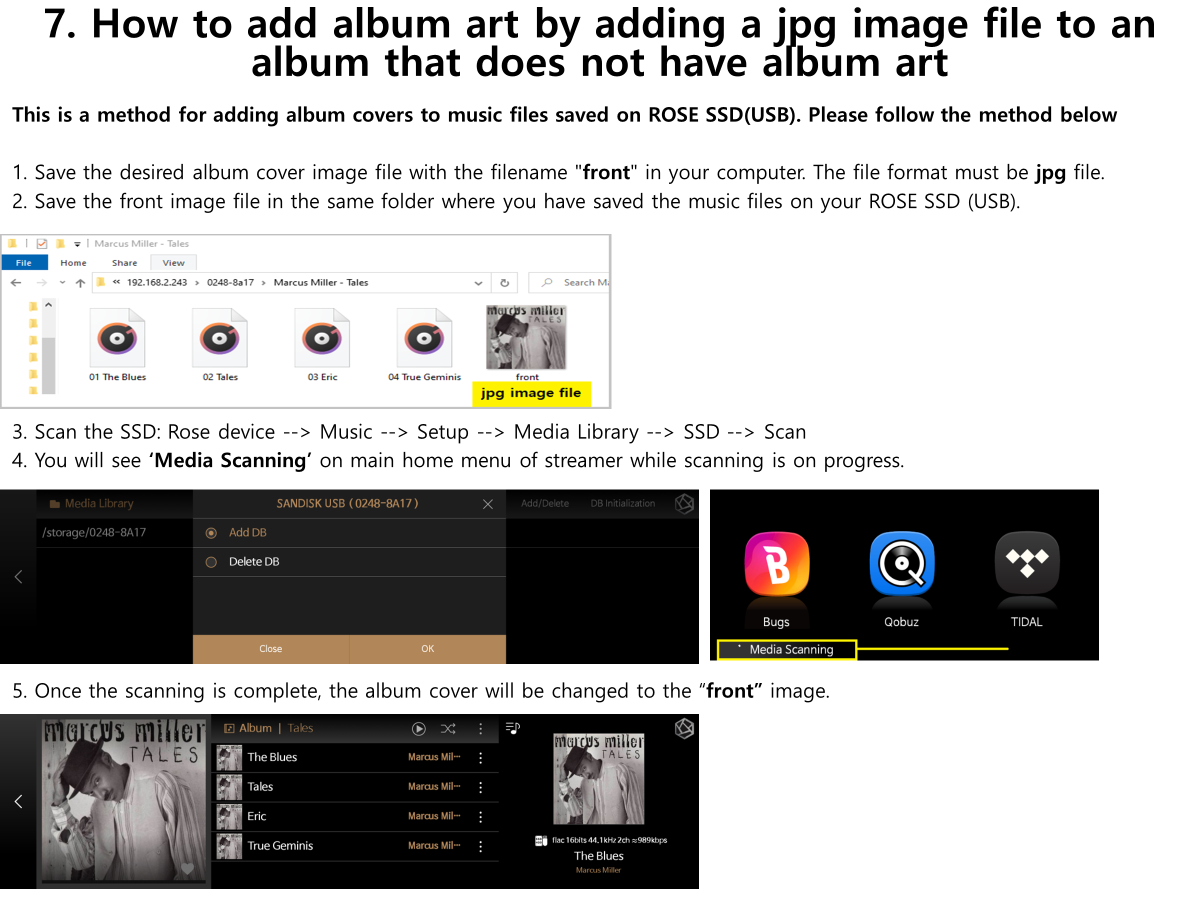
Because i have folders with jpeg « front » file saved in it, and no picture on the screen after the base scann.

Thanks for your answer

Found the following via Google:

The HiFi ROSE system primarily organizes and displays music using metadata tags (like Artist, Album Artist, Album Title, Song Title, Genre, Track Number) embedded in the audio files, rather than relying solely on the file names or folder structure.

For consistent and correct display within the HiFi ROSE app (RoseConnect), it is highly recommended to:

  • Use proper metadata tagging software (such as Mp3tag or MusicBrainz Picard) to ensure all files have correct and complete embedded information.
  • Organize files in a logical folder structure as a backup and for use with other applications. A common and recommended structure is Music (top level folder) > Artist > Album > [Track Number] - [Song Title].

While the file name format Artist - Song Title can work for a basic list of single tracks (as noted by some users), it is generally insufficient for managing a full music library, as it omits crucial album information and track ordering details. The HiFi ROSE app is designed to present your library using the richer, tagged metadata.

By focusing on correctly tagged files within a clear folder hierarchy, your music will be properly categorized by albums, artists, genres, etc., within the HiFi ROSE interface.


In summary, before scanning your disk library:

  • Step 1: Ensure all files have the proper metadata fields fully updated, including cover art and the MediaSource/Media tag.
  • Step 2: Ensure your folders are properly structured

Album Folder Structure:

Example of a double disc album & of single disc albums:

/Music ← for Videos, name the folder: “/Music Video” or “/Video”


/Music

  • /Pink Floyd
    • /The Wall
      101 - In the Flesh.flac
      102 - The Thin Ice.flac
      201 - Hey You.flac
      202 - Is There Anybody Out There.flac
    • /Wish You Were Here
      01 - Shine On You Crazy Diamond (Parts I-V).mp3
      02 - Welcome to the Machine.mp3
      03 - Have a Cigar.mp3
  • /Various Artists
    • /Guardians Of The Galaxy - Awesome Mix Vol. 1
      01 - Blue Swede - Hooked On A Feeling.mp3
      02 - Raspberries, The - Go All The Way.mp3
      03 - Norman Greenbaum - Spirit In The Sky.mp3
    • /The Crow - Original Motion Picture Soundtrack
      01 - Cure, The - Burn.mp3
      02 - Machine of Loving Grace - Golgotha Tenement Blues.mp3
      03 - Stone Temple Pilots - Big Empty.mp3

I use the following structures;

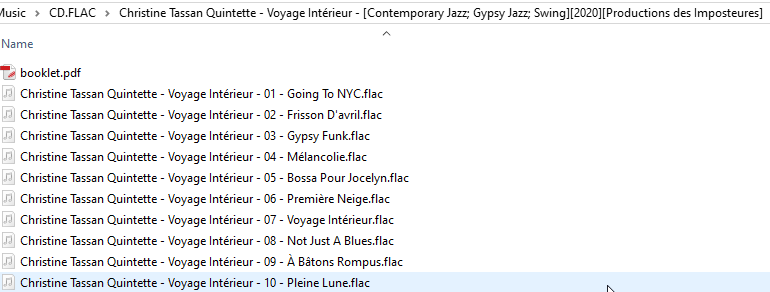
The top ones i use most often, the other ones lower down are for special cases usually found on classical albums. I tagged all my music files and developed a naming convention for directories and files so that they can be understand by humans only on the file system,

This is the naming convention for directories; Music\CD.FLAC<Album Artist> - - [][][]\

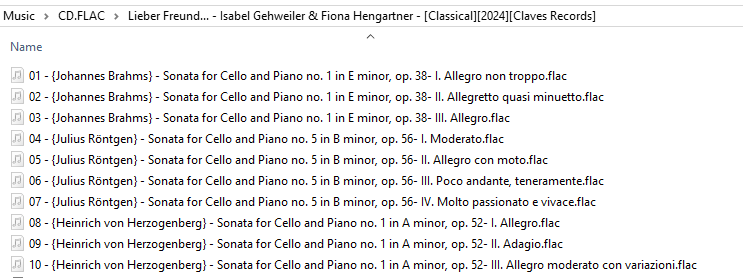
THis is the naming convention for the classical music files inside the directories; - - <Disc#:2>.<Track#:2> - {} -

and so on.

The main limitation for your design is the 255 character limit in Windows

Full tagging is important to fill the music files with all available data so they can be used in audio players and software.

image

image

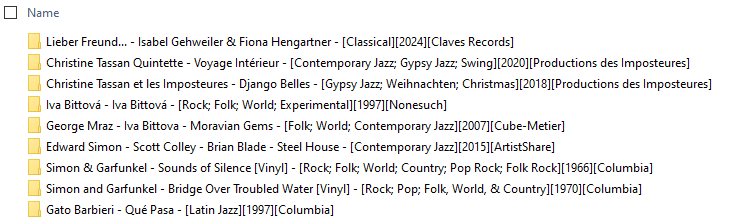
What you see here is the naming convention which is automatically used by using the tags in the music files. I do not do this by hand. I use Media Monkey 4, a media management application, and addon for this kind of work…

In short i use tags to automatically create a directory and file names and move this files to their destination directory which is automatically created as well.

The Windows Explorer then looks like this;

image

classical music:

image

For other music it looks like this

image

Enjoy the music !

1 Like