
Hi Everyone. I have a HifiRose 151 and I am testing the 280 amp. Does anybody know what the best pre-out level settings are for this combo? I use a XLR balanced cable between the 2.
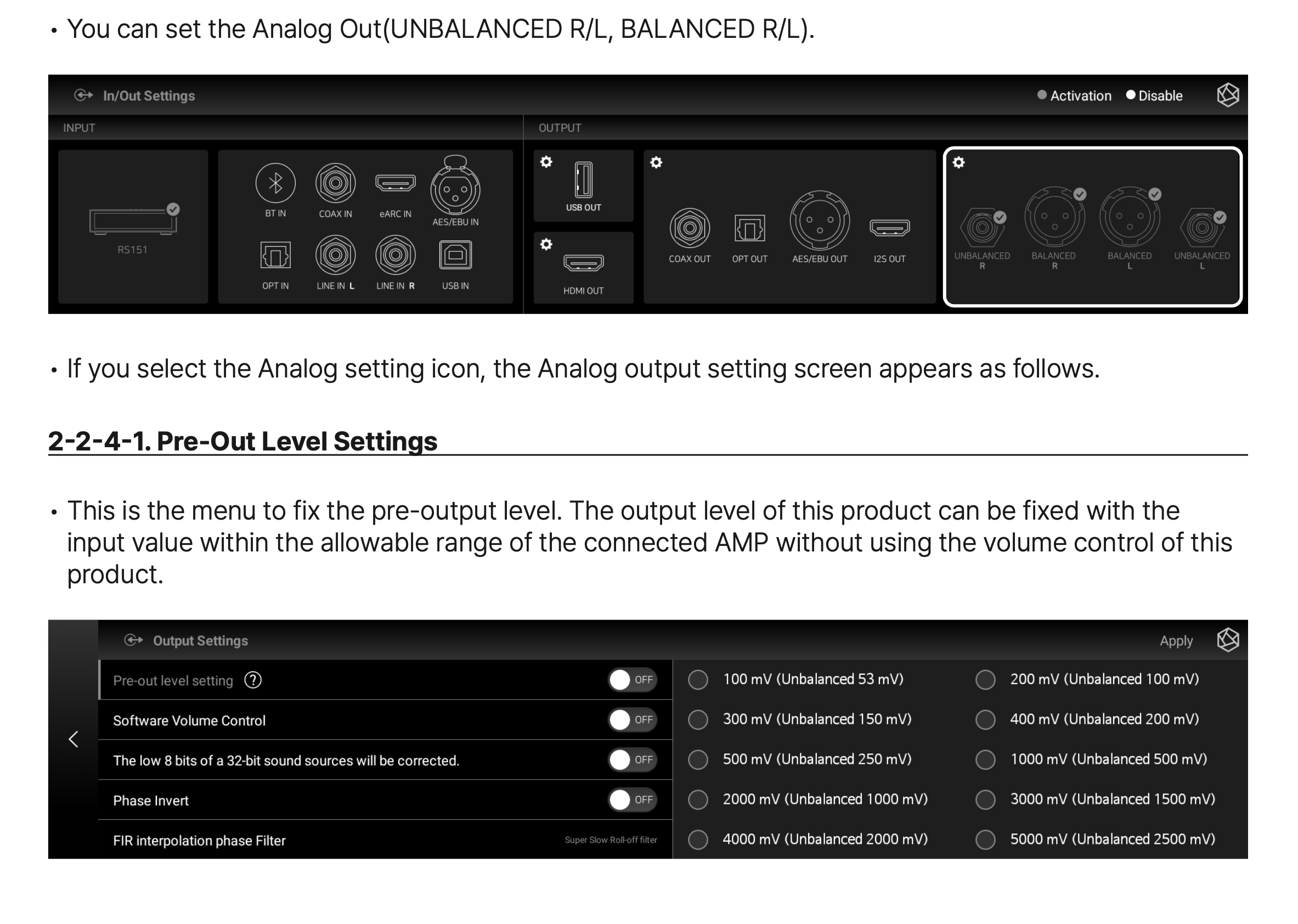
- XLR: Fixed 4 Vrms
- RCA: Fixed 2 Vrms
If you look at the options… there is no voltage option for XLR only RCA.
That said… you’d want to use line level out and then use the AMP to control volume.
If you were going to amps that do not have any volume control, then you’d need to use software volume control and start with the default values.
The screen very much lists both balanced sand unbalanced options, with balanced being double the unbalanced level for each setting…
As @VIK mentions, 4Vrms for balanced connections is more or less standard and should work fine. If you find that 280 does not give you enough gain, you could bump it up a bit (or vice versa).
Yeah. Looked at it and saw the unbalanced. They put both on the same line.
my bad.
If you’re connecting the RS151 and RA280 via RCA, set the pre-out level on the RS151 to 1000mV or 2000mV and use whatever setting sounds best to you.
If you’re connecting the RS151 and RA280 via XLR, set the pre-out level on the RS151 to 2000mV or 4000mV and use whatever setting sounds best to you.
Dear ROSEHAN,
I would like to clarify your statement:
- for RA280 XLR input, set the pre-out level to 2000mV or 4000mV
- for RA280 RCA input, set the pre-out level to 1000mV or 2000mV
According to RA280 specs input sensitivity XLR/RCA is only 600/300mV. If my DAC output is set to 2000mV, RA280 VU meters often go to the red zone. IMHO that could provoke extra distortion. Could you please clarify that point?
Kind regards
Possibly my consideration and my test way would be wrong, for your setup. but you can try it. I also use a separate VU meter display device.
If you have a streaming subscription, look for test tones like this.
Use the 1000 Hz (1 kHz) sound. But turn down the volume and see what the VU meters in the 280 show. I don’t know what settings the VU meters in the 280 have. Do the VU-Meters have the display in dB-Full Range or do they have dB depending on the volume? If the VU meters in the 280 are properly calibrated (which the digital ones on the displays of the streamers and AIO devices are not), they should see an optical difference in the 280 VU meters at different input levels.
When they get to the 0dB on the VU meters of the 280, with the test signal, they play music and hear whether the music distorts. If everything is correct, they have found their starting level of their DAC. In many cases, the synergy of devices is not correct and the given settings of the manufacturer do not apply in this case (either too quiet or distorted).
Do the test, it doesn’t hurt. 
And as I said, it could also not work with their setup.
Hello Bonte,
I’ve followed your advice and used Sony test CD with 1000 Hz 0dB tone. In order to set VU meters to 0db my DAC 2000mV output has to be attenuated to 600mV (-10dBV).
Conclusions:
- Your idea is perfectly implementable. Thanks a lot!
- RA250 VU meters are perfectly calibrated
- ROSEHAN advise so set output to 2000/4000mV is misleading. That will provoke clipping and distortion, specially on modern remastered loud and highly compressed tracks
1 Like
I think you should listen to Rosehan on this one. I mean, you are talking about two Rose products, the 151 and 280. He knows what the input sensitivity of the 280 is and made his recommendation.
Don’t turn up the volume to the point of distortion. Or experiment with lower output settings on the 151 until you are satisfied that you bound the correct balance.
Hello ptch,
I have to correct my last tip regarding the level adjustment via a 1 kHz test signal and the VU meters of the integrated amplifier HiFi Rose RA280. I have once again deeply familiarized myself with the circuit matrix of the devices: **Unfortunately, this test method does not work with this combination. **
Why the VU meter method fails:
The analog VU meters of the RA280 do not pick up the signal rigidly at the analog input, but hang behind the volume control directly on the output stage (power amplifier). They indicate the power output at the speakers and are therefore completely volume and level dependent. Since the volume pot is in between as a variable, the pure input voltage of the streamer cannot be reliably adjusted to 0 dB.
Since the forum always recommends extremely high and adventurous values for the output voltage of the RS151, here is the unadorned technical reality of how to set the station wagon really perfectly and hifideler-friendly.
The problem with too high mV values:
Many users turn up the output voltage in the RS151 to 5,000 mV or the maximum of 6,500 mV. The result: The combination becomes extremely loud, the volume control of the RA280 can hardly be controlled sensitively and it is celebrated on the net as “more dynamics”. Technically, however, this is a mess. A level so massively exaggerated stresses the analog input stage of the RA280, leads to early clipping (distortions), robs the music of the spatial depth and makes the treble sound pointed and exhausting.
The only correct attitude according to international standard:
In order to obtain the cleanest sound, the lowest distortion factor and the optimal control path on the amplifier, the output voltage of the RS151 must be adjusted exactly to the input sensitivity of the RA280. To do this, go to In/Out Settings → gear symbol of the output → Pre-out level settings (Fixer starting level) in the RS151 and sets the following values:
-
With RCA connection (RCA / Unbalanced): Rigid to 2,000 mV (2.0 Volt Vrms). This is the worldwide HiFi standard. Everything about it overdrives the input levels.
-
With XLR connection (Symmetrical / Balanced): Rigid to 4,000 mV (4.0 Volt Vrms). This corresponds to the international studio standard for balanced signal transmission.
Forget the forum myths because of “the more tension, the better”. With exactly 2,000 mV (RCA) resp. 4.000 mV (XLR), the DAC in the RS151 works in the absolutely optimal linearity range and the RA280 thanks you with an extremely clean, airy sound and a pitch-black background.
But let Rose’s professionals answer, they know their own devices better than anyone else.
Best regards Bonte
In my RS 151, I have the following settings:
With the XLR connection (symmetrical/balanced): Rigid up to 4000 mV (4.0 V rms), and the UV meter works as it pleases; it has nothing to do with the dynamic range of the disc I’m playing. On my Accuphase amplifier, the deflection of the diodes in the E-800 is 50% smaller.
It’s a bit better if I turn off the volume control, but I might need to lower the volume, because I think I had it set to 85% at the moment.
When I listen, I’ll lower the volume and see.
I can’t understand how the Rose IT staff didn’t notice this anomaly, because it’s hard not to notice, or maybe they didn’t want to. At this point, this meter is a useless gadget, in my opinion, it adds nothing, just art for art’s sake.
1 Like
I agree with you. I just don’t know how Rose calibrated the VU meters. When I look at my analog VU meters next to it, they turn out differently. Well, I know they get a full range signal in dB mode. So it shows how loud the song was recorded. Not to be confused with volume dependence.
And real analog VU meter is the true vintage style. My two VU meters are 8.5cm x 4.5cm long/high and can be seen from three meters as the crow flies on my sweet spot. I love the amber color, just like in the 70s/80s.
I also have amber backlighting on the Accuphase meters, and from a distance of 4.20 m from the device, everything is visible, while in the case of the Rose, this is impossible, for several reasons. Firstly, the display is still too weak, another model, it has to be OLED in the case of the successor to the RS 130 and RS 151. Secondly, the resolution of the digits on the meter display in the ROSE needs to be improved, half of them need to be removed, because they don’t contribute anything. All of these bright ones are difficult to see even from 2 m away, and it would be better to focus on those few and make it look much better than it does today.
1 Like
I am sure about 2 points:
- DAC max output volage must be equal to the amplifier input sensitivity. Higher DAC voltage provokes clipping = distortion.
- As indicated in RA280 User’s Guide analog VU meters “Displays the level of the sound source signal in real time measure the input signal”. It’s easy to check. Changing RA280 volume doesn’t affect VU meters. Changing DAC output volume does affect VU meters
I am testing RA280 in combination with TEAC UD-701N streamer-DAC. It’s XLR max output volume at 0dBV is 2000mA (industry standard) and can be adjusted from -95dB to + 24dB. In order to match DAC max output voltage to the amplifier input sensitivity I have to attenuate DAC output -10dB from 2000mV to 600mV. That has been successfully tested using 1000Hz / 0dB tone from Sony test CD running on CD transport.
I wonder why RA280 has so low input sensitivity (600mV) while older RA180 had industry standard 2000mV input sensitivity on XLR and 1000mV on RCA.
I wish Rosehan could enter the discussion and give his arguments.
He will do that!
If you now say that it is a full scale signal that the Vu meters in 280 show, then the test method is still applicable. Just like my analog VU meters. You get a full scale signal in dB mode. So you can reduce the volume and the measuring devices show exactly how loud the song was recorded. If the test method, as you posted, works, listen and observe.
Clipping could not occur with you, purely theoretically at all with such moderate input sensitivity.
A full scale signal (often measured in dBFS - Decibel Full Scale) refers to the maximum digital level that a system can process. 0 dBFS is the absolute upper limit. If this value is exceeded, hard, disturbing clipping (distortions) occurs, as the waveform is cut off.
Technical details for Full Scale
In contrast to analog systems, in which (often at +6 dBu or +22 dBu) there is a tolerable range beyond the nominal volume, in digital the end is reached at 0 dBFS. All real values below the maximum are negative.
-
0 dBFS: The theoretically and practically highest value of a digital signal.
-
Headroom: Since the loudest music passages or sudden impulse peaks (transients) should not strike at 0 dBFS, ideally leave a buffer. In the recording studio or with the digital volume control, a headroom of -12 to -18 dBFS is often recommended here to safely prevent any digital overdrive.
Practice in the hi-fi sector
In digital hi-fi playback (streaming, CD), the maximum level of recordings is often controlled exactly to the 0 dBFS limit.
-
Digital/analog conversion (DAC): A high-quality DAC must be constructed in such a way that it cleanly converts an attached full-scale signal into analog voltage without over-controlling the subsequent amplifier electronics.
-
Modern Loudness (LUFS): While the absolute peak (Full Scale) is relevant for digital control, in practice LUFS (Loudness Units relative to Full Scale) is mostly used. This unit describes the perceived, average volume over time and is used by streaming services (such as Spotify or Tidal) to automatically bring titles to a uniform level.
PS:
But I also have to say that I can calibrate my analog VU meters with a maggot or slotted screw to 0dB with 1kHz signal.
There is also a VU meter with a rotary potentiometer, where you can adjust the gain, i.e. calibrate.