
While the spec sheet of the RD160 stated that the 50 ohm clock input is an SMA port, I don’t really see any difference between the 75 and 50 ohm port on the actual device. They’re actually both BNC ports right?
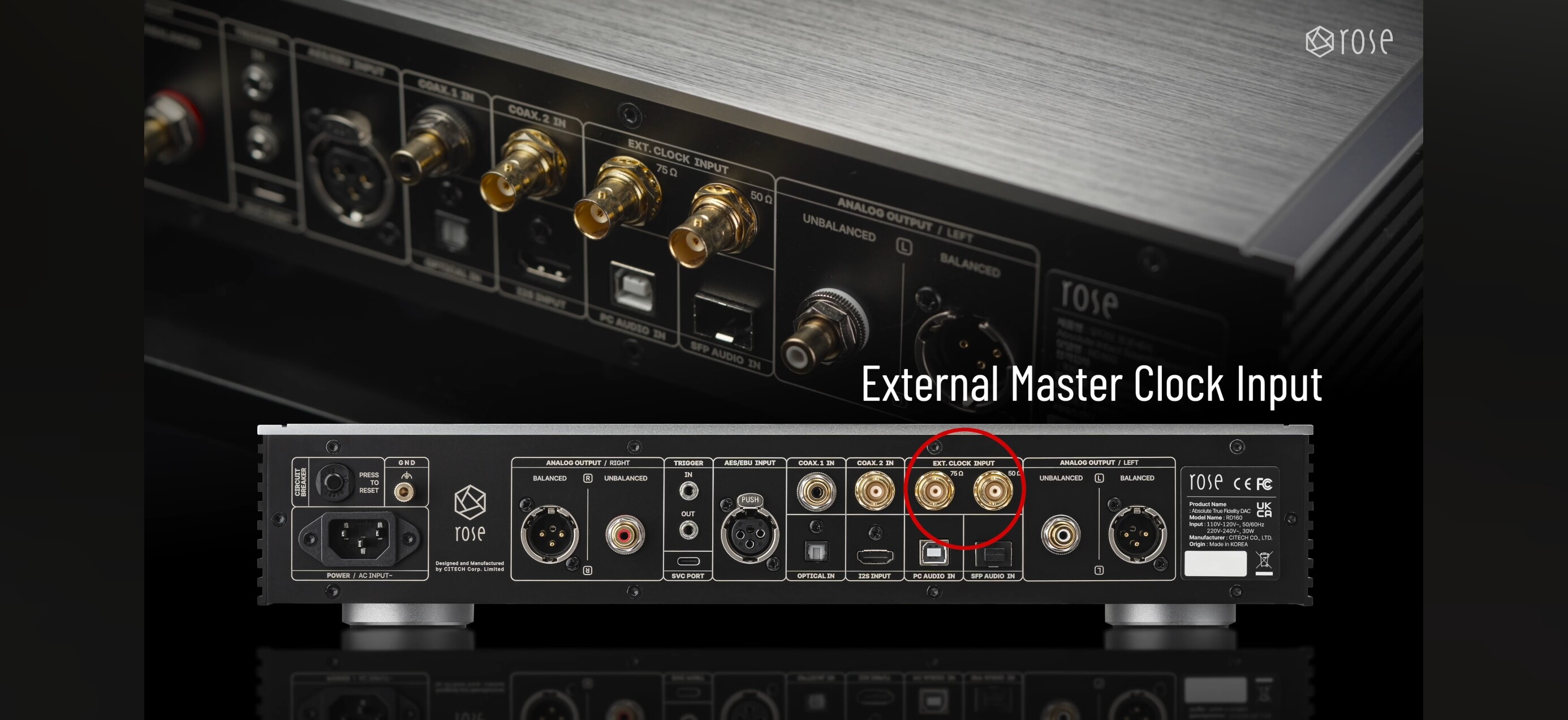
Both are bnc. I checked it on my device. And use it currently with mutec ref10. 50 ohm bnc! For sure.
Newbie question: What encourages people to get an external clock? What’s the difference/advantages between 50ohm vs 75ohm external clock?
The theory is that you’ll get improved sound if you’re using a single clock signal throughout all of your digital components.
The reality… not really.
Everyone talks about jitter and ignores drift. But that’s a different issue.
The reality is that in your DACs and other digital components many now have Femto clocks where they are more than accurate enough for their tasks. So the odds of you hearing any difference is extremely low. Ed aka Old Guy Hi-Fi recently did a video on this.
I wouldn’t was money on an external clock unless you are into time pieces.
Hi, I too am intrigued by external clocks and their potential. Finding information and meaningful reviews has proven troublesome. I contacted a dealer and enquired about such, and a DDC was recommended (and loaned) for evaluation, a Denafrips Gaia 15th… in my system it was revalatory. The added depth and control was most welcome; the sound now much more engaging and ‘emotional’. I urge you (and all) to investigate such. My 130 and Chord DAVE\MScaler combo is now flying!!!
Sound Reproduction depends on many factors in the chain. In my setup and with my taste in resolution and colour with my favour in specific music-styles and compositions and so on I came to the conclusion to run a masterclock, mutef ref10. With very short industry cable rg400 by huber and suhner with 50 Ohm. For my taste sound is less nervous, more stable and let me follow music and musicians with more ease. Separation is better. Well, others may optimize other parameters. No problem for me …
You are not going to hear a difference.
Look, the clocks in you Rose gear are already overkill in terms of accuracy.
No seriously. You have a femto clock. Worst case… 100 femto seconds or .1 pico seconds. 10^-13 seconds. (jitter)
In a master clock, you solve drift, but the jitter is going to exist albeit the same for all devices.
Its well above the audible range.
What do you think you’ll get w a common clock?
Hello Smegel,
many “gets” depend on specific setups. Look; I like to use Neumann active loudspeakers, the KH420. Some people told me, that they must be completely horrible for my music taste. Other people … Perhaps for them … But they didn’t like Bach Cantatas or his works for Solo Violin. So, well. They believe, that I should like a different setup. Puuh; very difficult approach.
To come back to your question: With my Masterclock I get more accuracy, less edges, more foundation in sound. Better separation of instruments and more natural “Klangrede” in music reproduction. More fun, more taste. The RD160 is not getting to another peak, but RD160 is climbing above in sound reproduction with a masterclock. My Mutec Ref10 was developped for professional studio setups. I use it with AES EBU input for PCM and - since Version 1.46 - with I2S for DSD. Much appreciated for my taste and in my setup; especially with microscopical loudspeakers, which I like very much and others don’t …
Dear HiFi Rose users
The 50-ohm and 75-ohm clock input ports on the RD160 are both provided as BNC connectors on the actual device. We will internally review the specification sheet description again.
The effect of an external master clock can also vary depending on the system configuration, listening environment, and personal preference.
Thank you for sharing your experiences and feedback. We will continue working to improve performance and compatibility.
1 Like
Could not agree more, Frank. Using here my RD160 with a LHY OCK-2P.
1 Like
Thanks a lot, Coolhighend. Frank.
Frank, you want to use a master clock… that’s cool.
But the master clock protects against drift and the clocks in these machines are really good.
Jeff Gehrling ?sp? a Pi enthusiast just did a YT video on his master clock for networking.
Here he pointed to a clock board that used a typical computer clock that wasn’t very accurate and he showed how the master clocks helped to keep it accurate.
Yet here we’re looking at clocks being femto accurate and when you think about 5ns as the time it takes for c thru a piece of copper. That’s on the range of 5ns. In Jeff’s example the worst clock was off by 60ns which is still in the mHz range in terms of audio.
What components are you using your external clock to sync, or are you just using it for a more precise clock that the one in the RS160?
Hello Smegel,
thanks for your reply. Hopefully I can answer your questions sufficiently. First of all I use a Mutec Ref10 as external masterclock. It is connected with rg400 cable by huber and suhner, 60 cm long. So it is linked on the 50 ohm side, both bnc. More technical details you will find here: MUTEC – Digital Audio Equipment – High End | Professional Audio - REF10
Hey Frank,
I understand what a mater clock is… I was asking what you were connecting to it?
Just your RD160? Then you are using the more accurate master clock over the internal clock of the RD160. At 60cm or .6 of a meter… c thru copper is going to be around 3ns depending on the wire. That is going to be greater than the jitter on the higher end clock that’s within the unit. (Although if you know the length of the wire, you can account for that )
If you have other components connected, then you will be using the Mutec to synchronize the clocks in the unit. This would be different, and some have said that synchronizing the clocks in the digital side has benefits… however there’s a lot of variables to determine how much of a difference and if that difference is audible.
So you have to consider the jitter as well as drift that can impact sound in terms of smearing the signal. Again here. you’re talking about something that is minimal.
Consider this… there’s a rule of thumb that you should make sure your speaker wires are both the same length. Now suppose for an experiment, you made one speaker cable twice as long. One cable is 20m the other 10m. For each meter of extra cable, you are looking at roughly 5ns so that’s 50-60ns delay in one channel over the other. Can you hear the difference over two speaker cables that are the same length? (This could be more pronounced if you used lamp wire instead of good audio cables.)
Now suppose you could hear a difference. Cut the one cable by 1m each time. (Or just replace with a shorter cable using the same wire. )
There’s more to the experiment like setting it up in an anechoic chamber… taking measurements… etc …
In truth. most if not all people doing casual listening won’t hear a difference. If you were doing a critical listening test… it would be an extremely small percentage.
There are a lot of variables here and depending on your speakers, you may get more of an audible improvement if you upgraded the quality of the components in your speaker’s XO. (It will depend on the quality of the components in the speakers to begin with.)
1 Like
Hi Smegel,
thanks for your reply. The biggest problem however: no double-blind-test at home possible or easy to be proceeded …
And yes; I connect the RD160 only with the Mutec Ref10.
I will come back to you soon,
Frank
… to keep it short. My Rg400 by Huber and Suhner, 0,6 m length, causes a delay of about 2,9ns. It is a constant delay, which does not increase jitter. The “jittering” timebase keeps constant. But I fully agree, that the effect in sound-reproduction depends on very many other factors, as music-material, loudspeakers, dac-architecture and so on …
So the 2.9ns is the propagation delay due to c thru the copper cable.
That’s in line with most good quality cables.
In terms of jitter… jitter isn’t constant and its around 22 fs for the Mutec Ref10 per a Google query.
1 fs is 1x10^-6 ns (1 millionth of a NS)
So its a non-issue with this clock. I mean it will take a while before the jitter became a noticeable drift in time.
Now per Google… which referenced a SkyFi Audio review… the High-precision OCXO clock has jitter that is around 50.000 ps or 50ns.
So 22fs vs 50ns … big difference.
But this is where it gets interesting.
Can you hear the effects of 50ns of jitter in your system?
So I asked Google… The AI response suggested that 50ns is on the cusp of being audible to some and in certain critical listening situations.
In digital audio, 50 ns (nanoseconds) of jitter is typically too small to be consciously audible as an overt error to the human ear. However, depending on the nature of the timing error, it can border on the limits of perception in highly critical listening environments. [1, 2, 3]
Audibility Thresholds at a Glance
To put the number into perspective, (1\text{ ns} = 1,000\text{ picoseconds (ps)}).
- < 20 ps to 50 ps: Practically inaudible. Modern consumer DACs typically operate well below 1 ns.
- 50 ns to 250 ns: Often considered the threshold for audibility. Historical tests by the BBC and research into random “white noise” jitter show that timing errors in this range can sometimes be perceived by highly trained listeners on complex, critical source material.
- > 250 ns to 500 ns: Generally audible. At these higher levels, jitter can blur subtle spatial and frequency details, causing a loss of definition, a narrowed soundstage, or a slightly fuzzy treble. [1, 2, 3, 4, 5, 6, 7]
Here’s a link to a YT presentation on this… https://www.google.com/url?sa=i&source=web&rct=j&url=https://www.youtube.com/watch?v%3DZT_1UATci3c&opi=89978449&psig=AOvVaw1jyhxGQpoXLa0xqyJQD7Uo&ust=1779751786059000
1 Like
One thing to consider… the AI result of the RD160’s clock to have 50ns jitter.
I did find the source of these numbers:
https://www.hifinews.com/content/hifi-rose-rd160-usb-dac-lab-report
edit:
Here is an interesting article on clocks and jitter…
https://audioxpress.com/article/audio-electronics-is-digital-jitter-really-a-problem
1 Like
@ROSEHAN
Can you share any information on the clocks used in Rose products like the RD160 and RS520?
The information that I can find on the internet is all over the place.
I don’t expect it to be close to the specs of the external clock but I would expect the clocks to be less than 50ns.
Thx
Thanks, Smegal. I will keep an eye on your investigations. By the way: that is the reason, a forum is a good place to be: information exchange. I will come back to you. Frank
1 Like