
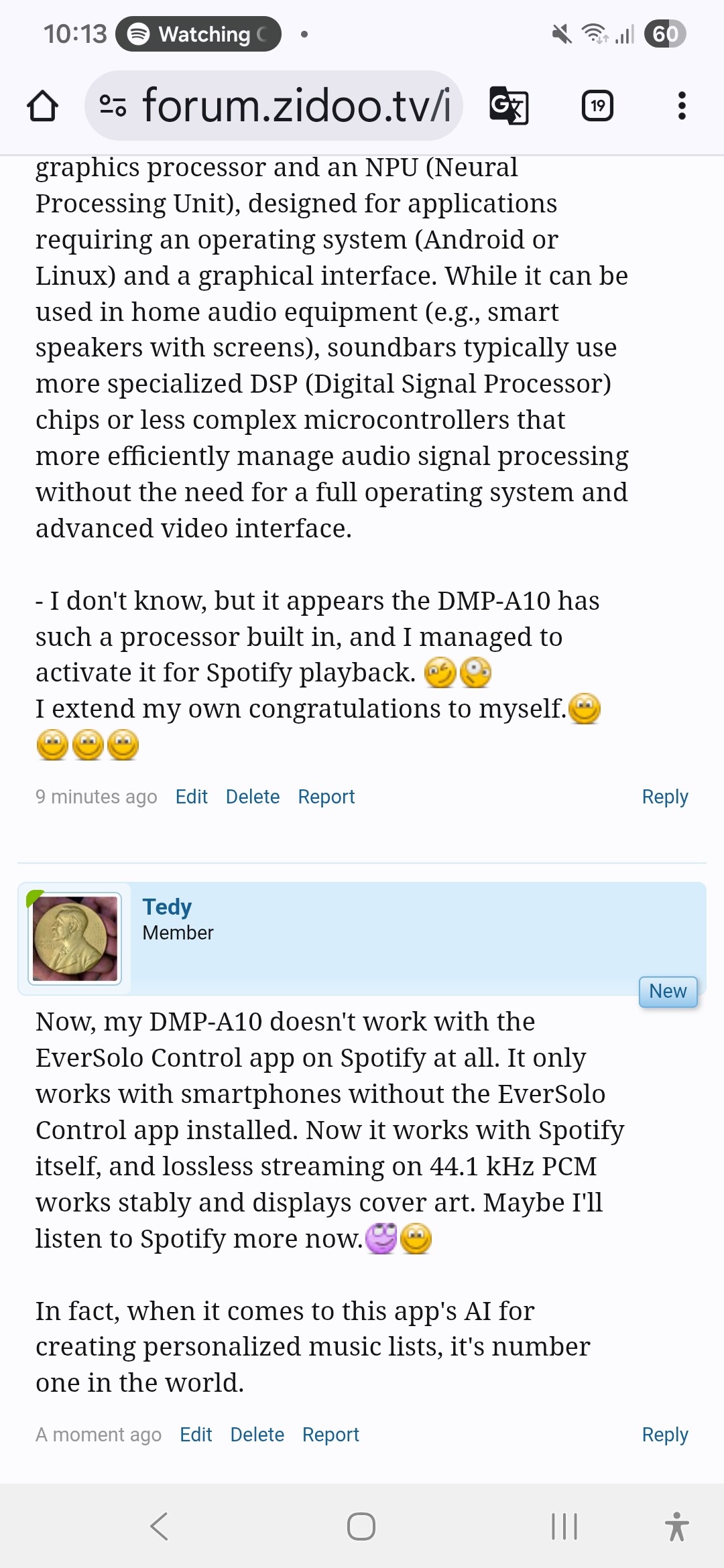
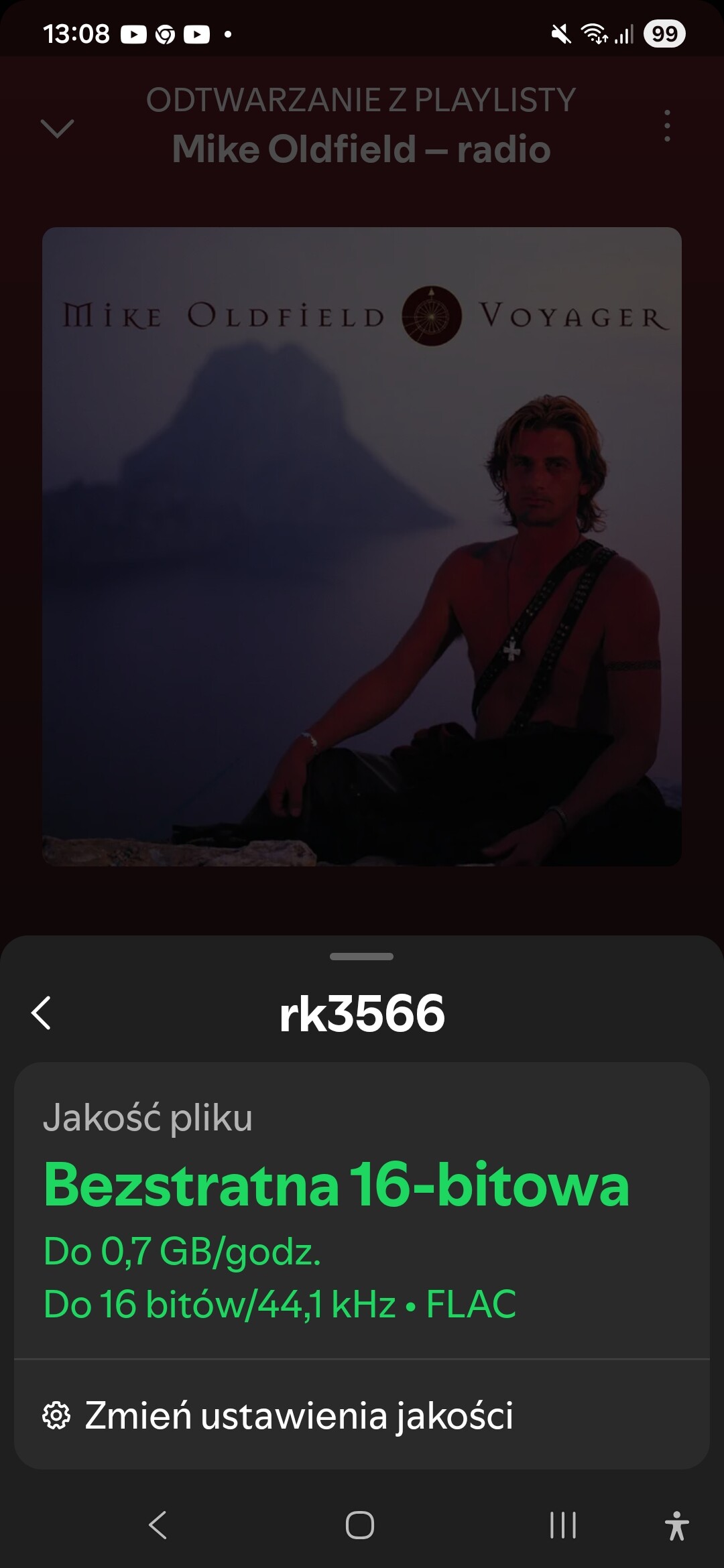
Now, my DMP-A10 doesn’t work with the EverSolo Control app on Spotify at all. It only works with smartphones without the EverSolo Control app installed. Now it works with Spotify itself, and lossless streaming on 44.1 kHz PCM works stably and displays cover art. Maybe I’ll listen to Spotify more now. 

In fact, when it comes to this app’s AI for creating personalized music lists, it’s number one in the world. 
I’m sorry, your post doesn’t make a lot of sense.
What that guy was saying doesn’t make any sense.
My condolences to you.
This knowledge is not for everyone. 
Looks like you’re in the wrong group.
This is not an Eversolo group.It’s all about HiFi Rose
I’ve been on this forum for three years now – because for three years I played on the RS150B. And two months ago I bought a DMP-A10 and heard “heaven.”  Rose is in a lower league. I’ve put the RS150B aside. The RoseHiFi app is a disaster compared to EverSolo Control.
I wrote this to open some people’s eyes.
1 Like
Eversolo launched Spotify Connect in a lossless version.
Rose is one of the few companies unable to launch both Spotify Connect and Spotify Lossless.
Comparing a device you bought 3 years ago against something that was recently released and then complain how bad the RS150 is? Really?
I listened to the RS130 and RD160 in comparative tests with the DMP-A10. And the EverSolo DMP-A10 won. 
And the RoseHiFi app is still as weak as ever. Your surprise is astonishing. Rose hasn’t caught up, and the world is slipping away from them. 
1 Like
For information’s sake, I was determined to buy the RS130 and RD160. But I listened to the EverSolo DMP-A10 and my jaw just dropped after listening.
The Chinese at EverSolo have a world-class design and development team. I didn’t believe it before either.
One could compare it with DMP-A6, too, which is quite old.
Sure.
The reality is that there are a lot of good options out there.
Everyone is gushing over the Eversolo… and you could look at the A6, A6 Gen2 and ones w the upgraded power supply. You can even find them used for a decent price. (YMMV)
The best deal right now for an AIO is the Arcam Solo Uno if you can find it for $250 or less on an Open Box. The downside is that you’ll never get Spotify lossless because the model is discontinued but some places have it in stock. For that price… you can’t beat it. If you were paying MSRP… you’d be foolish because its around the same price as the Play w/o the CD player.
Personally I wouldn’t buy the add on device to get Spotify Lossless. You want it… find a DAP like the iBasso DX180 that has SPDIF (COAX) out. Then you have a portable player to boot. Or a headphone out if you use USB out from the RS520 to the DAP.
If you wanted a headphones jack, go out and buy an Onix Alpha Xi. Its $100 or so. Best CS based DAC out there. (You could find other players too YMMV depending on what you want.)
For those who are griping about not having spotify lossless…
I have to ask… can you really tell a difference between HD and lossless?
I know I can’t. (You could set up your own ABX test if you want to.)
Most are griping about it because its a check mark on a feature list and other players have it.
You could also gripe about the use of ESS DAC chips (except for the reference DAC that uses AKM)
The A10 is nice, but you still need an AMP. So what do you use?
A, AB, D, G or H class amps? And in class D, do you go w a TI chip? Infineon GaNFET? Or something else? (Custom GaN)
For me… I’d pair the A10 w Orchard Audio Monoblocks…
Some could go w powered speakers.
The point is that there are a lot of options and griping about not having lossless is like pissing in the wind.
If you’re not happy, sell and move on.
Sure, if you want an obsolete used box, at least it’s cheap. Or, you could buy for an extra $200 a Wiim that is better in every respect, is new, comes with warranty, and, yes, supports all those things that neither Arcam nor Rose ever will.
You don’t really need to ask, with the same master nobody ever heard any difference between Red Book quality and any high-res, and the vast majority of people would not hear any difference between a high-rate MP3 and the original anyway. This is purely for warm and fuzzy feeling.
And you would not hear any difference between those and a TI amp either. At least those are better designed than Rose’s amps though.
“I have to ask… is there really a difference between HD and lossless formats?”
I’ve noticed significant differences between lossless Spotify and lossless Tidal, especially for 24-bit/96 kHz. So, during the day, I play Spotify as background music (they have a great AI for creating playlists, though), and in the evening, when I want to contemplate music, I only listen to Tidal, preferably in 96 or 192 kHz.
Some say these lossless formats are fake, but I hear the detail and depth of the soundstage.
Spotify does not even do 24/96 and they likely have different masters, so this is not a valid comparison.
In every proper test where the same original is used, nobody was ever able to tell the difference between 16/44.1 and DSD512 let alone 24/96. Most people would not even tell the difference between a 320kBps MP3 and the original, although for some sounds, with quite a bit of effort it is possible.
“Spotify doesn’t even support 24/96 and they probably have different master files, so this comparison isn’t accurate.”
I wrote the word “especially.”
Which significantly changes the message. Of course, Spotify took a few years to painfully develop 16/44.1 streaming. And compared to Tidal, 16/44.1 loses out in terms of final sound quality. I wasn’t writing about most people, just my own impressions. For informational purposes, in my youth I had my hearing tested—at my university, AGH—in an anechoic chamber and it turned out I had absolute pitch.
I still have a lot of it left. 
Nope. Assuming the same source data, there won’t be any audible difference.
Which is great but unless you were also bitten by a radioactive bat  you still don’t hear 40KHz.
My DNA bit me. 
I used to have a maximum of 20 kHz. I was tuning my reel-to-reel tape recorders after replacing their heads, and the bias current was 19 kHz.
I used to hear it… long ago 
Luckily, 20KHz is captured perfectly at 44.1 sampling rate, and unless one decides to use some broken slow roll-off filter is reproduced fine, too. Although 24/48 would be the best format for distribution.