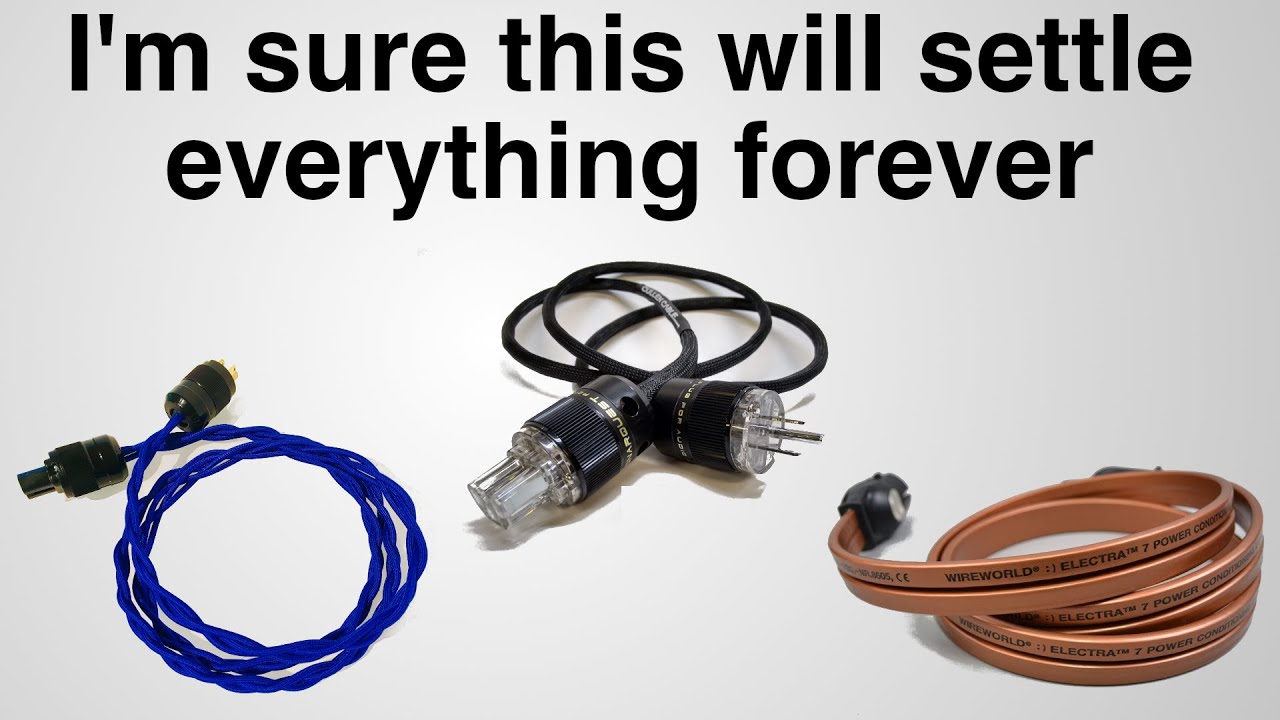
Who are you? Measurement fraction, or believers?

The US is different.
Your typical household electrical is 15A, you then have 20A single pull and then double pull circuit breakers.

You have various outlets based on the power draw. Your typical appliance , electrical gear is going to be Nema 5-15 and its a 15A circuit w 14ga wires in the wall.

You can go w 20A circuits , single pull or double pull and then go w different outlets in the wall. I have NEMA 5-20 outlets for washing machine, and for my power conditioner/battery backup for my mini rack. Then a different connection for the dryer …

But getting back to audio gear. Depending on the power requirements you will see your bog standard power cables mostly using 14ga wiring while those that would pull more power… (e.g. 1000watt power supply for a PC) will have 12ga wiring.

Also while not an audio thing… depending where you live in the US, the building code will vary. In Chicago, no ROMEX wiring in conduit… yet in places like TX and elsewhere you can use ROMEX.

Of course none of this matters for you in Germany.

As to the impact of the power cable on sound… YMMV again like speaker cables… there are several factors… (which you can see above. )

That is what I replied to the forum member—that if he moves to the States, he can use a power cable like that.

But you, of course, immediately drifted off into a whole different atmosphere again! :hugs:

Yup, it’s the same situation here—except that all our standard household wall outlets are identical, and power-hungry appliances—such as clothes dryers, washing machines, and so on—must all be designed to be compatible with the standard residential power grid. As previously mentioned, the electric stove—which draws the most amperage—is protected by a three-phase circuit.

Beyond that, you get into industrial standards, where large machinery is powered by high-current industrial supply lines. The standard there is as follows: an industrial power supply (three-phase current, 400V), when protected by a typical 16A fuse, delivers a maximum output of approximately 11 kW. However, that has absolutely nothing to do with our small audio system.

The only component in my setup rated for up to 400V is the main switch in the fuse box (which provides protection across the 230–400V range and up to 40A).

1 Like

There is one factor: either the power cable can supply the necessary power, and the device sounds as designed, or it does not (and the device doesn’t work as designed; and your house possibly burns down). You might as well be arguing that power cables affect the sound because if you take one out altogether there will be no sound at all! (Ha! Ha! Take that, ASR eggheads! Mikey had shown you again!!!)

1 Like

Just being thorough.
The issue is that if I say something and was not complete a certain someone would then jump in and say something…

So its easier to just talk about it.
And again its not just the cable but the connections and of course your underlying power.

:man_facepalming:t2: Oh Mikey, please stop.
You’re acting as if you buy new cables every day, swap them around, and then actually perceive differences in sound. :laughing:

@Bonte
You start this thread mocking people who believe that cables matter and then ask if they can be justified.

I responded in detail about how cables… all cables can impact your sound.
How much will depend on several factors and whether or not you can hear them.

While I make my own cables… I’ve also planned out upgrades I may make down the road, including priced them out for specific components.

I’ve also thought about making my own power cable, but less reluctant to pull the trigger.

Well, then, we’ve cleared everything up.

Actually, my main question was whether you’re part of the “measurement faction” or a believer. I see you’re the latter.

So we’ve cleared everything up.

Don’t be afraid to make the purchase; everyone buys what they consider desirable, even if their conscience has to confirm that it sounds better, because the conscience has to justify the money spent.

Mikey, why don’t you start a thread where we might actually agree for once.

@Bonte
You believe this to be an orthogonal question.
Its not.
You can look at measurements as well as listen.
The measurements show differences. The question then becomes are those differences audible.
The answer to that question becomes… it depends.
OK?

Then the next question… is the juice worth the squeeze. That’s going to be a personal question that only the person with the wallet can answer.

Personally I believe that there is a benefit to making a superior product, however going w expensive exotic materials isn’t worth it. Going w a hospital grade outlet vs builder basic makes sense.
Going w a 12ga wire over 14ga wire in a power cord makes sense.

Everyone here can have a different opinion. How much do you want to spend to upgrade a component. Someone just said that McIntosh said run w our cable. That’s his answer.

But if someone wants to make a silver clad power cable? Hey its his money. He can do what he wants until his wife finds out…

I posted all of that.

“Everyone buys what they think is good or right.”

And if you can’t hear any difference in sound—even if you can prove “something” through measurements—then such cables aren’t justified, which was/is my sub-question.

A single post from you saying, “I’m a believer, and there is such a thing as cable sound!” would have been enough for me.

You yet again miss the point.

You start the thread mocking people who hear a difference in cables and discount that there are measurable differences.

Now I have friends that were skeptical and then they replaced their power cables and heard a difference. Ok.

I’ve heard a difference when replacing my dongle’s USB-C cable. Everyone jumps to the fact that the bits still move as fast… yet they ignored the impact the difference in the amount of power than can flow thru the better (USB-C 4 cable. )

So there you have it.
I’m not going to mock someone over this.

Fine, Mikey—whatever. You twist my words around, refuse to admit your mistakes, etc.
As far as I’m concerned, you’re an ignoramus; Boris isn’t actually all that wrong about a lot of things.

I’m out… Good night.

Just because you’ve completely misunderstood what had caused the difference is a “you” problem.

1 Like

Boris,
Please be quiet. Grownups are talking.

I had no misunderstandings as to what caused the improvement in sound on my dongle dac.
Those on the ASR crowd didn’t take the time to actually read what I wrote.

They assumed, much like you… that I was talking about how the bits were somehow better on a more expensive cable.

There’s more to this Boris so please pipe down and listen first.

Bonte,
People are going to believe in what they want to believe.

You put a diode on a cable… its going to be directional.

Then there’s the question of purity of copper. And yes that actually does matter. Not just in audio.
There’s a German der8uer that runs a PC modding company and has a YT channel.
So you’ll see people buy into AliExpress companies pitching 7N or 8N copper.

Kimber Cables does a lot of the work in house… hence the expense. Is it worth it? I don’t know other than there’s a company in China that manufactures a similar wire and weave.

There was another German YT channel where they measured the cables and found differences. Then the issue is if those issues or an order of distortion was audible. And this is where things get tricky.
Suppose you have an audible distortion yet something in your room or in the sound chain covers it up. Meaning its there. It could be audible but not in the test system… so that others w other components will hear it?

This is why I believe in the measurements … to a point… but also to what people are saying … to a point.

Not the answer you wanted to hear since you believe its one or the other.

As to directionality of the copper?
That’s interesting. Do you believe that you can have a single crystal wire?

This post was flagged by the community and is temporarily hidden.

1 Like

There we have it again, Mikey!

“Do you believe…”

I don’t even believe in a full wallet.

Because my wallet is made of “onion leather”—and whenever I look inside it, it brings tears to my eyes! :laughing:

I don’t even “believe” in the laws of nature, because they are factual and verifiable—at least on this planet, our Mother Earth.

Just try dropping a rock on your foot sometime!
That’s called gravity, or the Earth’s gravitational pull.

If you had told me that different loudspeakers sound different, I would have been right there with you. But when it comes to cables—provided they meet, or even exceed, the correct specifications—I’m out. I don’t “believe” in anything there. And as I said, even if you can prove something using measurement technology, it doesn’t necessarily mean you’ll hear it. Our brains play tricks on us, and our own conscience needs to justify the purchase of such expensive cables. So it stands to reason that people will always say: “Yes, that $4,000 cable has phenomenal sound.” Call it whatever you like; to me, it’s just the placebo effect or psychoacoustics.

Did you watch the videos? Especially Video 2 (“Are Cables Really Directional?”). In that one, you can see how “moonshine cables” actually degrade the sound quality.

And if your browser has a built-in translation feature, check this out as well.
It’s not a video, though—you’ll have to read it yourself, or have it read aloud to you. It explains everything you need to know about Hi-Fi—covering everything from what constitutes “snake oil” to what is actually useful. :arrow_down:

https://www.hifiaktiv.at/startseite/

1 Like

:arrow_up: Mikey, you won’t get rid of that thing. This lapse on your part says everything about your faith. :hugs:

I guess Boris can’t take the hint.
When enough people complain… who knows what Rosehan will do?

Anyway to your point since this is your thread.
I told you what I believe in… and what I question.

Yes cables, including power cables can impact the sound.
Whether you can hear it will depend on you, your gear, and your room.
What is in audible in your environment could be audible in another, or not audible at all.

Now for the fun part. There’s this guy Jay who has a YT channel where he flips high end gear and spews a lot of the ‘audio-fool’ nonsense. One episode he had his buddies stop by and they were listening to some over priced speakers and did an AB testing (blind testing) between lamp cord and some very expensive speakers.

In the end… they overwhelmingly picked the lamp cord as the better sound.

The moral of the story… just because you can hear a difference doesn’t mean you’re going to appreciate it.

And leave it at that.