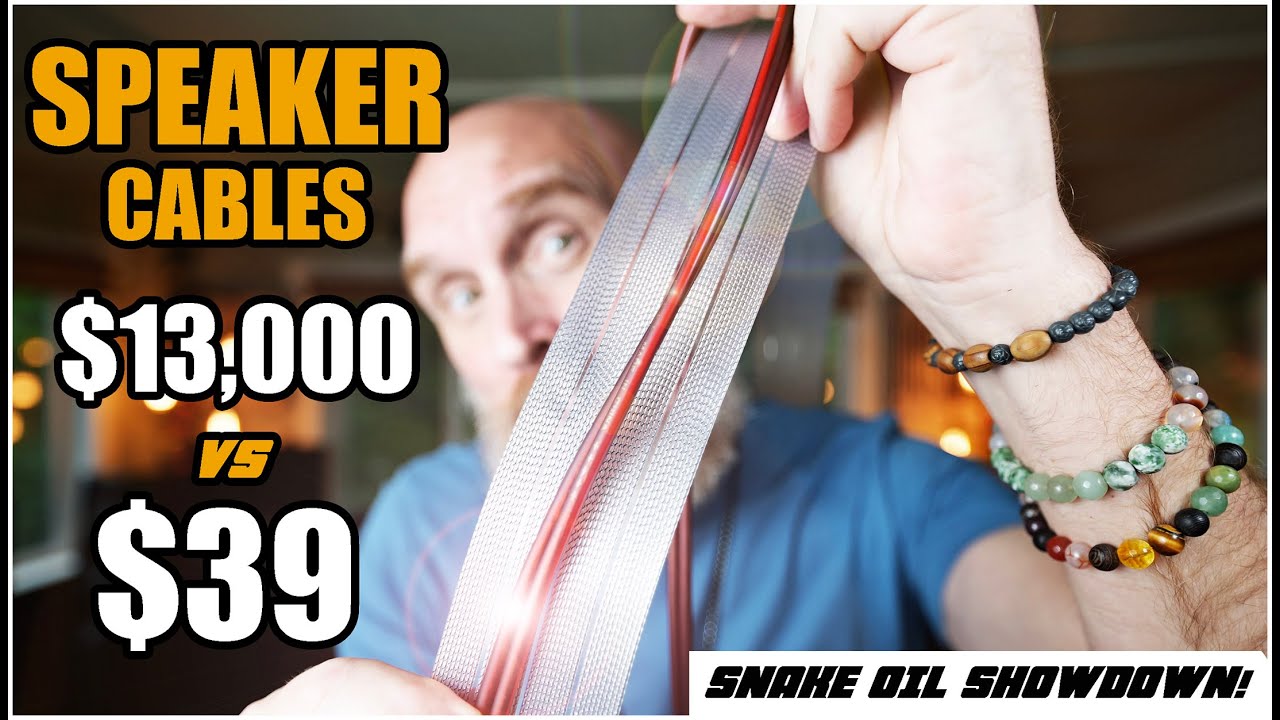
Who are you? Measurement fraction, or believers?

I used a pair of Valhalla’s and modified them to power cables to power to my washing machine… the colors of my clothes after they’ve been washed are so much better & brighter than before!!! Outstanding ![:open_mouth:]

Or:

Experimented with different brands back in the day. Each brand does have its own signature sound.

Generally speaking, this is about such expensive cables—and not just Valhalla cables. Are these cables really justified?

1 Like

HiFi Huff is easy on the ear but rarely says anything I believe. BTW Huff, timbre is pronounced tamber, not timber.

3 Likes

Just popped up into my feed.
Haven’t watched it yet.

YouTube suggested it to me as well.

But what do you guys—or you, Mikey—think of it?

I don’t believe that all Rose devices sound better with this—because if they did, it wouldn’t be HiFi Rose.

After all, Rose wouldn’t sell Hi-Fi equipment that sounds worse when using the included power cables.

Ok, the short answer… yes cables can make a difference.
Longer answer. IT DEPENDS…

Here’s an example that I have personally experienced and one that others have as well.

Upgrading the USB-C cable you use for your dongle dacs to a USB-C 4 or Thunderbolt 5 cable.

While you may focus on the fact that its a digital signal you’re missing the fact that it is also carrying power from your phone. And its the upgrade to the power carrying capabilities and the thicker grade of wire and shielding… that you get more power to your device. I did this w the Onix Alpha Xi which is a power hungry dac and had issues w some phones because they didn’t push enough juice thru the USB-C port. A second cable type had a USB-A plug just for power and allowed you to plug into a battery supply for more power as well as not running down your phone’s battery.

Then you can look at speaker cables, which is what that video was about.
Not that he also slams Boris’ hero Amir and ASR because they aren’t testing for the right thing.
Here you have an analog signal and that is definitely going to be effected by the wire and also connections.

In terms of power… yes, but to a lesser degree. Do you use 14 gauge wire? Or do you use 12 gauge wire in your power cables? Shielding? And then the connection end points. Quality components over ‘builder basics’ does matter. (This is always the case. )

How much it matters will vary based on a couple of factors.

So while your post was meant to be a joke… it isn’t.

Note too that the quality of the devices in the chain will also impact the sound quality. So if your kit is garbage… you will less likely hear a difference.

Does this mean that you should go out and buy expensive cables? Maybe. It depends on what you think is expensive. Speaker cables that cost $150 for 5m ? That’s $15.00 a meter. Which is more than lamp cord. Or did you mean $1500 for a 5m set?

Price is all relative. For me? I priced out making my own 15ft set of speaker cables. There’s the wire, the connectors, and then the covering material. It adds up. Especially depending on which connectors you choose to use.

Now of course YMMV.
And here’s another video you may enjoy…

1 Like

I’m in the camp of if it makes you happy and you might enjoy your music more and you have the disposable income buy whatever you want, and don’t worry what “trolls” say
Happy listening everyone because that’s what its all about…

2 Likes

Sure,

But I’m in the camp of where I believe that some people believe that they are hearing a difference.
This could be due to either a placebo effect… or that they did hear something. (psycho-acoustics) And because we are all different… not everyone will hear a difference. Note that whether they like it is a different issue.

Now if they actually heard a difference, then why? And that’s the issue. What’s the science behind that?

Some who follow Amir at ASR watched him test different op amps. He ran his ‘tests’ which showed that both op-amps performed as expected yet didn’t show why they would sound different.
If you question his methodology… you get banned.

The point is that differences in your music’s chain will cause a change in what you hear… to a point.
If there are issues in your chain… they may hide the differences so that you don’t hear it. Not to mention room interference.

Of course Bonte just wanted to stir the pot.

1 Like

In this context, I was thinking specifically of the 520 model.

Since it is an all-in-one unit—and assuming one uses it as intended—the only cables I currently need are a couple of RCA audio cables (in my case) for the pre-outs (specifically for subwoofers). We’ve already discussed speaker cables.

Apart from that, I once bought a power cable—one of those special “eclipse edition” types—but I couldn’t detect any “audible” differences whatsoever, so I sent it back. The simple fact is that swapping cables takes too long, and the human “mind” is notoriously bad at retaining a precise memory of sound quality over time.

Even when using the exact same cable, different musical tracks—or music in general—vary so much that your “brain” simply doesn’t manage to store a consistent reference point.

Furthermore, perception is heavily influenced by your physical state and the time of day:

Did you sleep poorly? Have you been fueling yourself with nothing but processed junk food? Or perhaps you’ve spent a long time in a noisy environment (like at work)? (Oh—wait, that last one probably doesn’t apply to you, seeing as you just sit at a desk at home.) In such states, the sound will seem completely different compared to when you first wake up in the morning, feeling physically refreshed and regenerated.

Try this experiment:

Spend two hours cutting firewood with a chainsaw while wearing headphones!

You’ll notice that the music sounds muffled—or perhaps overly bright—and seems to lack bass. This is a side effect of the hearing protection; the ear defenders exert pressure on your ears, effectively sealing off the ear canals due to that external compression.

Maybe I’m just an alien, but I notice this phenomenon every single day—whether I’ve slept poorly or have spent a long period in a noisy environment (even while wearing hearing protection).

In that regard, we all made a mistake during our youth. Sure, we were young and wanted to experience everything—to see and hear it all—but all those nights spent at discos and concerts actually caused damage to our hearing back then.

So, it seems you are clearly a true believer—even if it turns out to be nothing more than a placebo effect.

Well, good luck with the cable hunt then—but start with the 2k range; anything below that just isn’t worth it at all.

Cheers!

2 Likes

While there’s you, your emotion.
The Room and how it impacts the sound from the speakers.

But the question you raised is cables.

The issue is that you can measure the differences in the cable. The question is if you can hear it.
If the rest of your gear isn’t that great, or the room’s acoustics have an impact… you may not hear a difference. The differences can be subtle. And then its a question of what you prefer.

I prefer to make my own speaker cables.
I have been using some bulk Audioquest that I picked up years ago on sale and for my next set of cables. I will probably switch up to Mogami W3104 to test it. (There are a couple of other brands I may test too.)

In the states you can get bulk W3104 for under $7.00 a foot. Then there’s the connectors. Lots of options.
Then the shrinkwrap the cable covering which would be around $1.00 (USD) a foot. So lets say you don’t make any mistakes. Budget $250 for the bulk wire. (More than enough) then your connectors is where you can blow the budget.

So for $350 you can make speaker cables that will rival your $2K ones.
You can also choose different wire, connectors and make them for less.

1 Like

Nice deflection from a question about power cables to bleating about USB and a completely unrelated issue of trying to power a DAC from a phone. Which has nothing at all to do with USB cables, and any mythical differences in sound, and everything with using a device correctly.

Suuure. What could electrical engineers possibly now better than Mikey the middle manager?!!

What are Spotify’s system requirements, Mikey?

1 Like

Well, thank goodness tomorrow is a public holiday here; otherwise, I wouldn’t have replied, Mikey.

First off, I once again have to agree with Boris—even if you don’t like it. The discussion was about power cables. Furthermore, they saw my speaker cables. That thread is currently locked. Regarding the speaker cables, I told them that I paid €300 for two 5-meter lengths and that I no longer have to mess around with them on my own. I don’t think you actually read it at all! Even with these cables, I can’t hear any difference. What is measurable is light-years removed from anything you could possibly hear.

:arrow_up: And please, also take a look at the readout for my cable.

Speaking of which:
Even though I belong to the “measurement camp,” just because something can be measured—and the differences are visible on the test equipment—that by no means implies that it can actually be heard!

:rofl:…Well, Mikey, you have only yourself to blame for this.
In my view, anyone who parrots everything they hear from random “YouTube engineers”—or other dubious sources on the World Wide Web—or who actually puts their faith in such things (and there we have it again: faith) is, unfortunately, beyond help.

The wound is being torn open again and again, Mikey!

Or: Salt is being rubbed into the wound—over and over again!

The only difference would be to admit one’s mistakes sometimes. I imagine that if you did, more people would perceive you—and appreciate you—in a completely different light.

1 Like

Sorry I was talking in general.
But even just for power cables, the answer again is yes… but with the caveat it depends.

  1. What are you driving?
  2. Grounded/Ungrounded?
  3. Components.
  4. Wall Socket. (Which isn’t a part of the cable.)

Now in terms of the components… you have to consider the gauge of the wire.
Most household appliances will come with 14gauge wire.
So w a typical 15A circuit you’ll see 14ga wiring in the wall which is code.
You could see 12ga wiring which exceeds code for 15A circuits but required for 20A lines.

So you can see your black plastic cords (generic big box stuff) w 14ga wiring inside.
Or if you are going to draw a bit more current, they will have 12ga wiring.
(You will see this in some computer power supplies.)

Then you have the connections.
Better quality parts here do make a difference… to a point. And to be clear… you’re comparing them to what is known as ‘builder basics’.

Which gets into the wall outlets.
Builder basics have a lower quality parts, along w loser fitting. This is why some rave about ‘hospital grade’ outlets. There’s nothing special… just better components and a tighter fit. (Plus color and markings) You don’t want that battery powered IV drip to get unplugged.

Now the big question… will you hear a difference? The answer again is maybe.
Should you care? Again the answer is maybe.

McIntosh recommends using the supplied cable for its amps and plugging it directly into the wall outlet. Their word is good enough for me. That said, all of my breaker panels are fitted with surge protectors.

And that’s fine.
I have a bunch of spare power cables that I’ve picked up over the years.
I tend to save the heavier gauged cables. I’ve sometimes used them to replace the cables that shipped w the product. Mostly w computer equipment.

I suspect Bonte was asking this question as a bit of a tease for ‘audiophiles’ who spend $$$ on power cables.

14-gauge wire (referring to the cross-section of the individual conductors) is the standard for amplifiers and subwoofers. In our system, this corresponds to 1.5 mm² per conductor; this type of cable is designated—and functions—as a C13 cable, where the “3” indicates the number of conductors involved. Specifically, the third conductor serves as the protective earth connection. My subwoofers and other audio components all utilize this type of cable. Other devices—such as monitors or CD players—also typically use C13 connectors, but with a smaller conductor cross-section (usually 3 × 0.75 mm², or 3 × 1.00 mm² for devices with slightly higher power consumption). However, amplifiers—whether solid-state amps (which we affectionately call “trannies”) or tube amps—invariably require C13 cables with 1.5 mm² conductors due to their high power draw.

Even my 3400 and 520 units are fitted with C13 connectors, simply because I repurposed cables that I had previously used with other equipment. The original power cables for both units are still safely stored in their respective boxes.

However, this does not mean that I own any of those expensive, audiophile-grade power cables—the kind supposedly “handcrafted during the ebb and flow of the North Sea tides”! They are just bog-standard C13 cables (1.5 mm² per conductor) featuring a protective earth connection.

And why do you bring up “grounding”? Here, all such equipment is grounded by default and must comply with VDE standards. That is why our wall outlets and plugs feature “SchuKo” (protective contact) connectors. The only exceptions are small appliances using C7 connectors (CEE 7)—rated, I believe, up to 2.5 amps—which utilize a “Europlug” design that lacks a protective earth connection. These are typically used for devices such as LED bedside lamps, electric shavers, or mobile phone chargers.

Exactly!

That’s what I meant above.

Rose certainly wouldn’t ship a high-end device with a poor-quality power cable. The same goes for Mac. That would be sheer corporate suicide.

Ok… so you’re getting to be like Boris.
Reread what I said.
In the US 15A circuits are the norm, w 20A circuits for the larger appliances.
So for 15A you will see 14ga which is the minimum required gauge of wire. You can use 12ga which is the minimum required wire for the 20A circuits.

So when you are going to be pulling more amps / power… you’re going to want a power cable that uses the larger gauge wires.

Why do I bring up grounding?
Are you telling me that you don’t have audio gear that uses an ungrounded cable?
You know like a blueray player? (That’s just one thing that I thought of off the top of my head. You could see other gear.

Mikey!

  1. You didn’t say it—you typed it!

  2. A standard household outlet in Germany is typically fused at 16 amps (A). At a voltage of 230 volts, this results in a maximum load capacity of 3,680 watts (230 V × 16 A) per circuit.

Of course, three phases are available for really “power-hungry” appliances, such as a stove or a high-voltage connection.

I only have the 3 phases for the stove.

So, if I want to integrate a PA system for stadium sound here, I’ll get a high-voltage emergency generator. We’re talking about apartments, not houses with attached workshops where welding or woodworking is done on high-voltage machines like routers or circular saws.

I can easily get by with the 3.6 kWh that applies to a single circuit (outlet :arrow_up:).

I don’t know the total power consumption of all my devices plugged into a socket. I just did a rough calculation a while back. In any case, I’ll never reach 3.6 kWh—that much is certain.

Yup!

The Rose, the Lyngdorf, and two subwoofers—all with ground connections.
The mobile phone charger, the MacBook (with a different charger), and the Fritz!Box power supply (used for audio, since it provides the internet connection)—all ungrounded, as they use small-appliance plugs (Europlugs).