Comparison of streaming amplifiers

:hugs: No, I didn’t misunderstand you.

I meant you should add some bass (woofer) to it, I think you’d like it too. You just have to try it out.

But if you think your main speakers are enough, that’s fine too.

I usually listen at room volume or even a little quieter, and with two subs, I get such a nice, rich sound at low volumes. Although the Lyngdorf does a very good job anyway because, as you said, the volume is only adjusted at the analog output and everything is purely digital before that.

1 Like

Everyone likes something different.
Like in the parable: The priest likes Catherine, and the organist likes money. :innocent: :rofl:

Personally, I listen quietly rather than loudly, because music is like air to me and surrounds me all day long. Unless, of course, my wife steps in. :grimacing:

1 Like

When I get up in the morning, I turn on the music. Then I go to work, and after work, I turn on the music again.

Then I stream something on TV and go back to sleep. That would be my standard routine. Of course, on vacation, I enjoy beautiful nature (water, forests, and meadows).

Oh, and don’t forget parties.

As I typed, I just meant with more bass when you add a subwoofer, and as I listen quietly, it fills your room much more.

Rough comparison:

You listen to your system and with subs, it’s like going to a concert (exaggerated).

Or: Four cylinders versus six or eight cylinders in a car.

This has nothing to do with shaking walls or pictures falling off the wall. My sound transducers and subwoofers are much too big for my room, according to the specified room dimensions. But that’s exactly what fills the room. I’m always talking about moderate volume. If I turned it up, I could make everything shake, and yes, I also love a few power reserves.

As I said, everyone has to find what works best for them, and this is just a little suggestion from me to try out how room-filling it sounds. :ear:t2::sound:

I also listen to music with a subwoofer.
But I always use it with CDs or vinyl. When I used the RS150B, I also used the PV1. The bass from the B&W is excellent, and it’s impressive from 20Hz. :hugs:
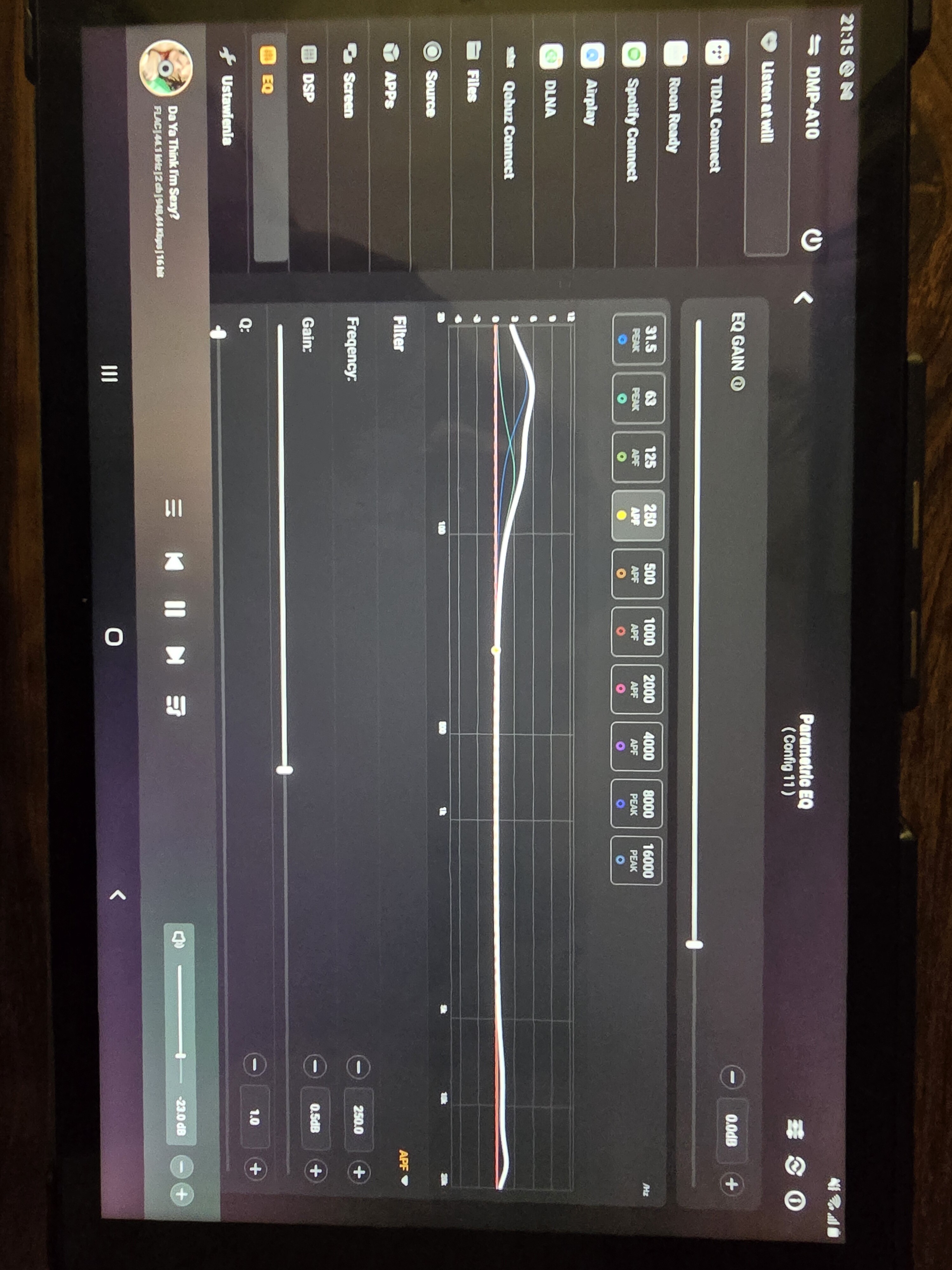
But once I recognized the capabilities of the new DMP-A10, I boosted the bass to about 30Hz, with a peak width of 15Hz or so. The effect is quite good, plus the analog physiological correction in the Luxman L-550AXII. Overall, the subwoofer is redundant. So, I understand if you like strong bass, you use two. I also use the amplifier at about 30% power because it’s going all day when I’m working from home.

That’s old enough that it probably wasn’t too good… and EzSet seems to be more about setting levels of speakers in a surround system, not really about room correction.

One thing to remember is that you do not want to just flatten the frequency response. Since you’ve got your speakers because you presumably like their tonal character, you want the target curve to be similar to their natural output, just removing deviations from it and fixing time/phase. Maybe some bump in the bass, but you won’t know until you actually take a look t hat they are actually doing in the room.

1 Like

You’re probably right. Certain experiences create stereotypes. :yawning_face:
I’ll probably try EverSolo Room Correction in the near future. I have to try it.

1 Like

Indeed. I think it is worth trying; and measuring first.

If anything, all 3 woofers in Cielos, being 6.5 inches, have less total surface than a single 12 inch driver in a smallish sub; and you drive them with a 35W or so amp rather than hundreds of watts that a subwoofer has. It’s straight physics that once you get below their roll-off frequency they just can’t play as loud and as clean as even a half-decent sub.

Looking at PV1’s manual though… it seems it only has 8 inch drivers, and looks like only one is actually moving air in the room. And the 500W rating seems to be… wildly optimistic, what with the power input being only 100 or 110 (depending on voltage version) watts. It probably can hit 500W at a momentary peak, and might be able to make windows rattle at 30-40Hz but not really much more. Seems to have been designed mostly for their mini home theater systems with tiny little satellites.

Properly integrated it should make an improvement but I would really consider something a bit larger eventually, if you ever listen to anything that uses a full piano range…

1 Like

Don’t forget that it’s not just the power in Watts that counts. Efficiency (in dB) is equally important.
Only the sum total is the effect. :sunglasses: :nerd_face: and resultant

Well, yes,m of course. But sensitivity is not measured at the lowest frequency the speaker can play. It’s not even measured the same way across brands and models. Some can quote the level of pink noise, some white noise, some will just do a sweep and pick whatever gives the highest value. Often they just measure a 1KHz signal and call it a day.

Just because Cielos are 92dB sensitive somewhere does not mean that they are equally sensitive at 40Hz and below; if they were, they would not be down 3dB there :slight_smile:

I would like to see standardization on how speaker sensitivity is measured, say 2.83 V, white noise, 1 meter, anechoic conditions.

I agree with Bonte. Subs are not about shaking the room and rattling the glass, especially when it comes to music. I have pretty good front speakers, but I admit that the subs add something. I also enjoy pure two channel, no subs.

Now there is something to be said in support of visceral, room shaking bass when watching a movie like Dune or countless others.

Multiple subs is not about multiplying SPL, but rather correcting room issues like modes and nulls. Good room correction also helps. It is a good time to be alive to be a lover of recorded audio. (Notice that I didn’t use the term “audiophile” because I don’t want to suffer the wrath of Boris.)

3 Likes

“Just because the sensitivity of Cielos speakers is 92 dB at a certain point doesn’t mean they are equally sensitive at frequencies of 40 Hz and lower.”

–Speaker Efficiency/Sensitivity (dB) is
Measured in decibels (dB) at 1 W/1 m. But there is no specific methodology for such measurements. :face_with_hand_over_mouth:
It’s just an indicator for the listener’s choice. I’m not a Chario seller. I simply really like my Aviator Cielos. I’ve had many other speakers, but these completely meet my expectations. :heart_eyes:
And I actually play at 10 W, and the sound level is satisfactory. And there’s no point in commenting on that. I don’t intend to change anything in my optimal system, according to my assessment.

The final effect is just our individual assessment. Some people like a lot of sub-bass, others prefer a lot of midrange, and still others are deaf and think they hear high-end. :joy:

1 Like

:hugs: I repeat, if you love your system the way it is, that’s fine.

But don’t you want to think outside the box? Just out of curiosity (it’s human nature, after all).

And yes, you have a sub with 1x1 8“ drivers, but listen to subs with 12”, 15,“ or even 18” drivers. They can move a lot more air in the room (because they have a much larger membrane area). It definitely sounds much more voluminous.

But it’s a matter of personal preference when it comes to subs, and if you’re happy, that’s how it should be. Love your music and love your system.

2 Likes

Could be anything, as long as it is standardized. Unfortunately the best we get is 1W/meter of… something.

:rofl:

And I don’t doubt that they are probably good at what they do. If you like the sound, you like the sound. But physics is physics. Of course you don’t have to add a sub if you do not want to, but without it you are missing part of the frequency spectrum that is present in real music. And, at the same time, pushing the Cielos to play something outside of what they are really designed to do, where they just add some distortion.

The point of proper sub integration is that you are relieving your speakers of playing something they are not very good at (and your amp of trying to far more power than necessary just to try moving those 6.5" woofers far enough to do some bass) and letting a dedicated device with its own power reserves do it properly. That makes the speakers sound cleaner and better AND you get the full range of music reproduced.

All depends on the music though. Right now I am sitting in the office, with rather small bookshelf Revels that do not go much lower than 50Hz or so. Listening to Haydn’s piano sonatas, the sub does not even come on – Haydn didn’t use the left end of the piano much (technically, there still is something one could hear by manually powering the sub on and sticking one’s head into the driver opening, but not enough to turn it on by signal sensing, or hear from the listening position. But put on a symphony, and the sub very much comes on and the effect is very audible.

The point is not to shake the room with some random rumbling, it’s to reproduce the bottom range of what an actual instrument(s) can do at the correct volume and without adding too much distortion…

2 Likes

I completely agree with you here. :100:
You don’t need to explain it to me, because audio has been my passion for 50 years. That’s why I chose my profession – electronics engineer, specializing in electronic circuits.
But my choices in audio are also driven by emotions, like most of us crazy audiophiles. :rofl:
By the way, following your comments, I retuned my PV1 to a 40Hz cutoff (the filter isn’t steep) and adjusted the gain slightly, and now I yes even like streaming music. There’s more substance.

2 Likes

Comparison of streaming amplifiers - #47 by BorisM?

@BorisM, you’ve hit the nail on the head again! :+1:t2:

If only I could express myself like that…and how many times have I typed that to you.

:v:t2:

1 Like

And that’s a perfectly valid choice – after all we listen to music (well, some of us anyway :rofl: )for emotional effect. It’s when people start making objective claims that I often have to object.

I mostly deal with the software side but my grandma literally wrote a book on speaker design (professor of acoustics) and I have learned a thing or two.

40Hz should be better, although SVS’s sub matching tool suggests 50Hz but with a very steep slope (24dB/octave). B&W probably has a far less steep one so 40 should work as well… If you were to use e.g. EverSolo which can low-pass the sub and high-pass the speaker 40 with a gentler slope should work well. Best thing is to measure of course.

1 Like

“although the SVS subwoofer matching tool suggests 50 Hz, but with a very steep slope (24 dB/octave). B&W probably has a much less steep slope, so 40 Hz should also work… If you use, for example, EverSolo, which has a subwoofer low-pass filter and a high-pass filter, a 40 Hz speaker with a gentler slope should work fine.”

That’s why I set it to 40 Hz due to the design of this filter. I constantly emphasize everywhere that Man is analog. Therefore, I will not change my configuration and the PV1 will continue to be driven from the Luxman output. That’s my firm stance. :nerd_face: :100:

–p.s. If your Grandma is alive, then best regards and respect for her contribution to audio knowledge. :wave:
And you, listen to your Grandma’s advice. Because experience is great Knowledge. And great knowledge is also great Experience.

As long as you are happy with it. Many audiophiles tend to miss (or willfully ignore) the difference between subjective and objective. If one enjoys even streaming lossy Spotify to a Bose radio it is all good as long as they like it. If they start going on that such a setup is “more revealing” or “lifts veils” or is somehow technically superior, that is not fine t all…

My personal opinion is that high-passing the speakers would make for better integration but this way is fine, too. In this case though I’d remove the PEQ bump and if necessary adjust the level on the sub itself.

Thanks, but alas no… She’d be over 110 years old now.