
Having a few spare Burson opamps I decided to give it a go with my RD160.
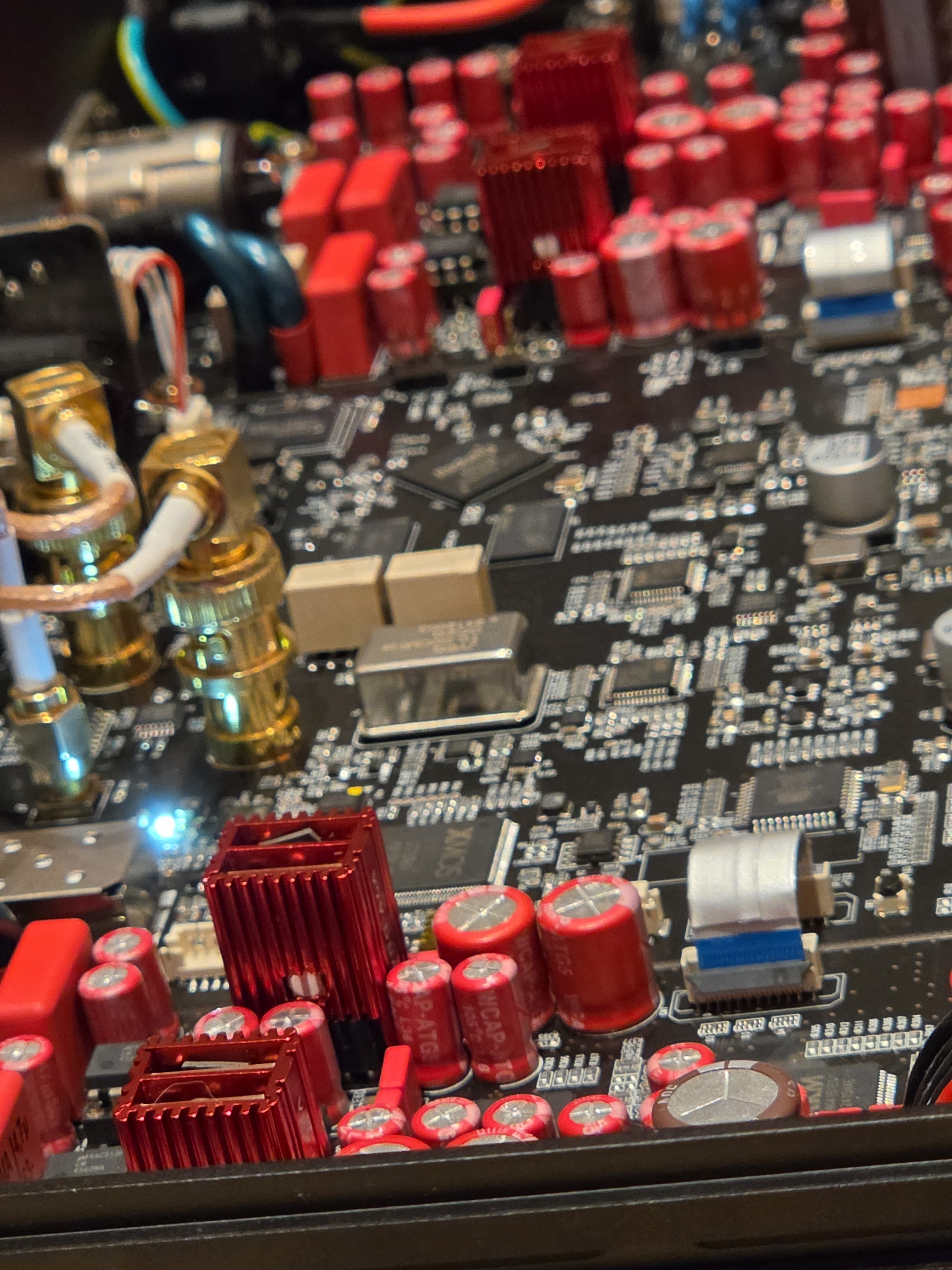
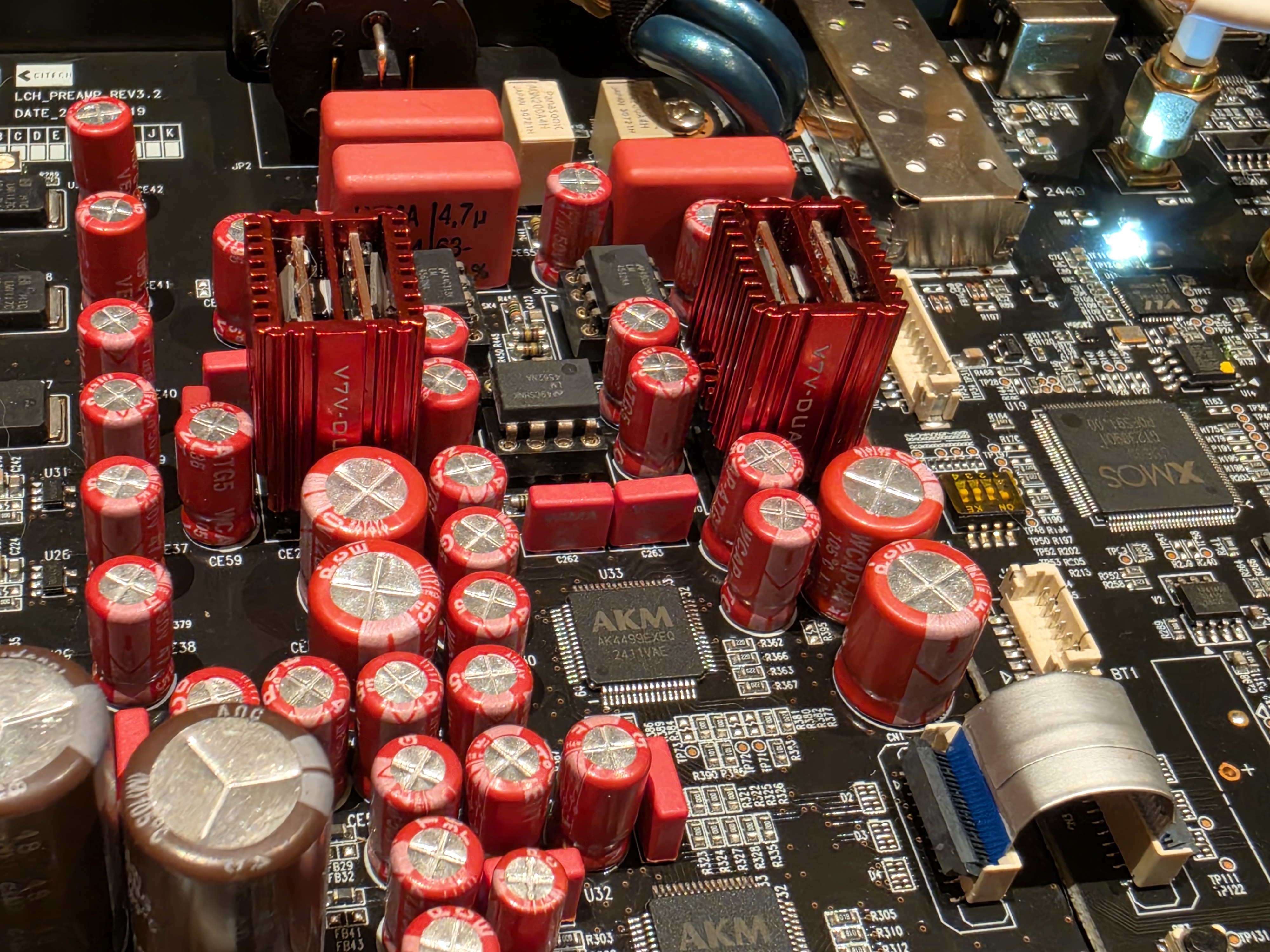
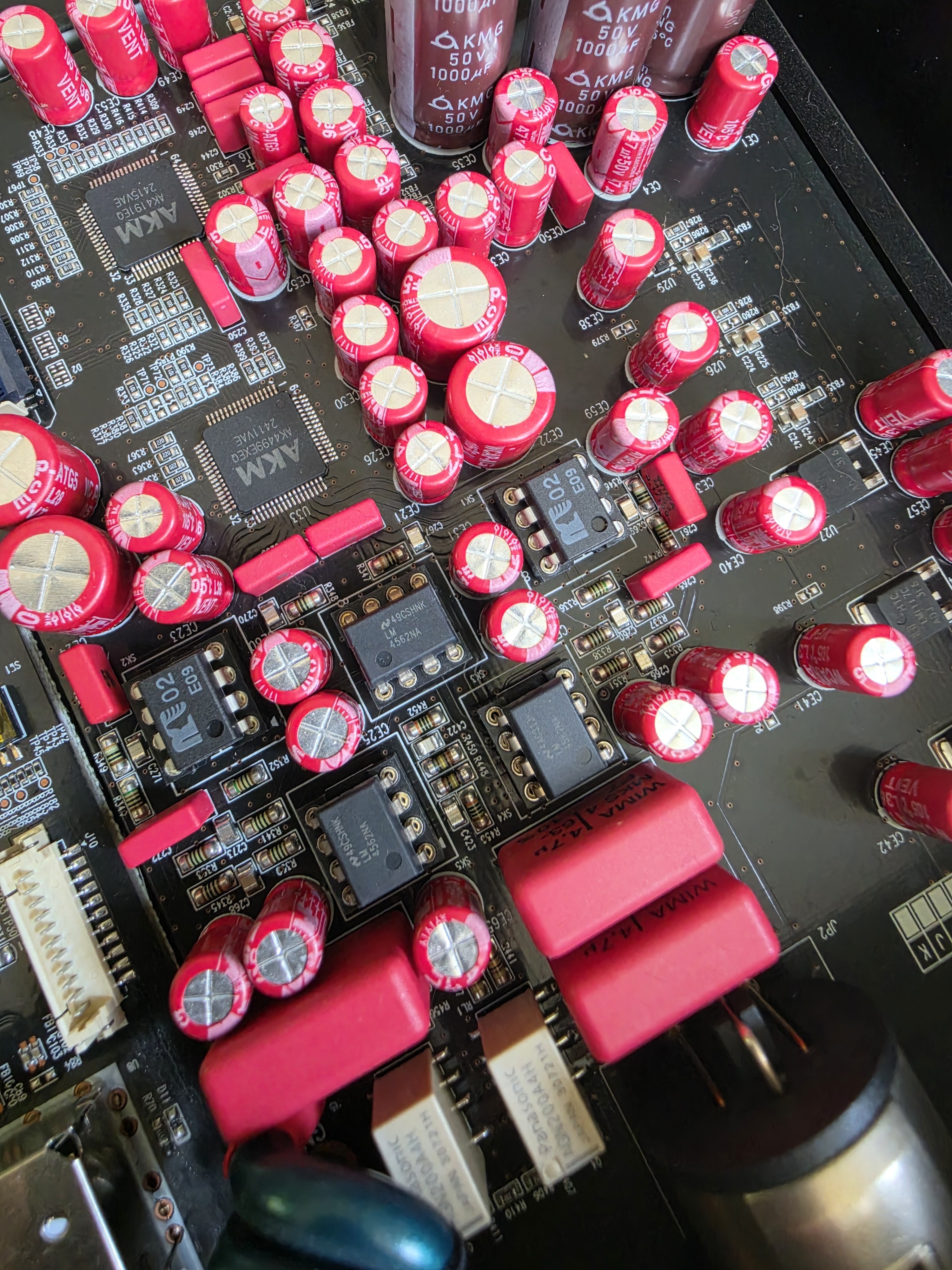
Originally unit was supplied with 2 Muses and 3 LMs per channel. Popped the Muses right off and installed the Bursons. Don’t know what to think of it as of yet because I haven’t had a chance for a decent listening session, but I’ll share my opinions in case anyone is interested.
3 Likes
Hello,
I was actually wondering about that myself; mine is apparently equipped with 5 Muse02s per channel, but buying 10 V7s just to test them out would be expensive…
I’m curious to hear your impressions.
I have already replaced the IEC connector with a Furutech FI-06 NCF and rewired it using Mundorf Angelique cable; the result was well worth it. I did the same for the RS130, adding an EMI filter behind the Furutech, and the result is excellent.
Hi Patrice,
I hear you…10 Burson opamps it’s 1/5 of the rd160 value haha.
For now I have two per channel but more are on the way. The only concern would be current draw if all 5 bursons are installed. Muses uses 8mA, while Burson about 35mA. Have to check what regulators are installed and if they can handle to load - don’t think there should be an issue.
So far i’m not impressed with the change, but again, haven’t had a decent listening session and will not have one in next two weeks.
Its cool that they have dip sockets in the RS160. Usually you see SMCs.
I am curious how the V7s will sound… but also that you’re mixing Op Amps. This is the first time I’ve heard of anyone doing that. Usually its an all or nothing scenario.
[Edit: I didn’t catch the LMs at first. Not sure if you need to upgrade these…
Looking at the AI response:
The LM4562 is an ultra-low distortion, low-noise, dual high-fidelity audio operational amplifier from Texas Instruments. It features a vanishingly low total harmonic distortion plus noise (THD+N) of 0.00003% and a voltage noise density of 2.7 nV/√Hz, making it a gold standard for high-end audio preamps and professional equipment. [1, 2, 3]
This kinda makes sense. So I guess you would want to leave these alone…
]
If you want a lower cost, Burson’s 5s are good.
You could also look at Sparkos, but I don’t know if you can get them to fit into that space.
(But that is a much more expensive option if you could swing it. )
Let the man science Smegel. You always make it sound like you have answers for stuff, even stuff that has never been tried before.
Kudos, MrBt, let us know what you learn.
2 Likes
Rolling op-amps?
Free clue how do you think I have a set of the Burson 5s?
Although I haven’t tried them on anything Rose has built.
The V7s sound different. Not difficult to hear the difference - it’s so obvious. Very analogue like, almost tube warmth. Richer, wider and deeper. I like it. It was a little bit overwhelming at first but, after I put Muses back, it became obvious what I prefer.
Next, I will try replace the rest of LMs with Bursons.
Also, I don’t use dedicated preamp. Rd160 goes straight to 2x KRELL S-275 > Wilson Sasha W/P.
2 Likes
@MrBt
What you’re reporting is very interesting, and it confirms the quality of the Bursons…
It would be interesting to know which of the five possible slots yields the best sound…
Personally, changing the IEC socket and internal wiring already made a significant difference in terms of warmth and detail; I might just go ahead and buy two sets of V7s to test them out.
Thanks for the feedback.
Just wondering what makes them Bursons sound so warmer, richer and tube like. Is it high level of oneven harmonics or alteration in amplitudefrequency .
I could change frequwcy amplitude in my system. But itroducing harmonics will be difficult l)
I am curious if you tried the different filters in the 160. If so, did you hear anything near the difference that you heard with changing out the op-amps?
Yeah but all DAC manufacturers do this unless you want to pay $$$ for a DAC.
They all build to a price point. Modding gear is part of the hobby. (Or a segment of the hobby)
The thing is that you can’t always go by price.
The Burr Brown chips are relatively cheap and many say they sound good… if you prefer that sound.
W.R.T Rose… they put those other op-amps in the signal path too. You don’t usually see that. So maybe there is something to their engineering.
I’m glad you like the Vivids. Their classics supposedly have a more ‘laid back’ sound.
There’s also Sparkos, I met one of their engineers at AXPONA… nice guy. Not sure if their top of their line would fit that space.
Its interesting that you added the extra EMI filter. Spoke w another manufacturer and he said it was due to DC voltage on the AC line coming in.
So you replaced the AC socket. Did you also build a new power cable? I’ve seen people switch up to 12 gauge or 10 gauge wiring over the standard 14 gauge wiring (here in the US).
I guess the next thing is to replace the clock chips w SC chips. Ian of Canada has them for sale…
@afa2022 @Smegel
Let’s be clear: I was very satisfied with the sonic performance of the RS130/RD160 combo.
I had some spare parts left over from another project (which I’ve since abandoned), and my RS130 was out of warranty, I wondered if adding these components might make a difference. I was pleasantly surprised when I listened to the modified RS130. I repeated the process with the RD160 and was pleasantly surprised once again.
Swapping out the op-amps was just a thought I’d had—I hadn’t actually planned to go through with it. In reality, I get a lot of pleasure out of listening to and discovering new music on my hi-fi system.
And just to keep the debate going: yes, I also use a Cybershaft clock to provide the timing signal for the RD160 and RS130… 
1 Like
Its all good.
Look, the stock RD160 is Rose’s flagship and has gotten rave reviews and it was one of the few if not only Rose product that made it into a lot of stacks at shows like AXPONA.
But as I said earlier, these are made to a price point. Everything short of the ‘money is no object’ gear is made to a price point. So there is always going to be room for some improvements.
Does the level of improvement justify the cost of making the improvement? Maybe. That’s subjective and sometimes its more about the adventure than the price. (e.g. building your own cables, speakers, etc …)
As to the clocks… this is an example of an SC cut clock that is supposed to be much better than some of the other clocks… albeit at a cost. SC-Pure Extremely-low Phase Noise Audio Clock – IanCanada
The wild thing… Amir at ASR ran his tests and claimed that all op-amps sound the same. I guess you can say differently. 
I made some progress in achieving tube like sound by using my Revox B77 tape recorder. 2 track high speed machine.
I loop the sound through recording and playback heads. Cranking up the recording volume past saturation of the tape gives that nice mellow tube sound. And its adjustable 
Next i will try different eq and bias settings.
It would depend on which Bursons. I doubt that you’d conclude the Vivid V7s sounded ‘tube like’ but maybe the classics would? (This is again subjective. )
The question you really need to ask… do you prefer the sound better than the stock op-amps?
- Buy an extremely sophisticated and expensive DAC. Nah, not really
- Assume Rose’s engineers inexplicably left substantial audible performance on the table. $$$ compromise
- Replace carefully selected semiconductor components with boutique ones. Why not?
- Change their current consumption substantially. Didn’t check their Vol Regs yet
- Replace the AC socket. Why not?
- Replace internal mains wire. ???Whats wrong with it?
- Add another EMI filter. Still, nothing wrong with it
- Listen without level matching or blindness. I’m not legally blind - dont have to listen blind
- Discover “more openness, blacker backgrounds and improved musicality.” Some have better sight, others have better hearing, more revealing taste buds…why not ears???
Indeed, it’s very subjective… Now I have 4 classics installed instead of 4 Vivids, and must say that the difference is quite confusing to me when I look at the Burson op amp comparison chart. All in all, it depends on system sound signature you want to achieve.
I have a set of lundahl output transformers that I used for I/V stage with my Oppo 95 and loved much more over Burson and Lampizator Tube. Probably some day I’ll try them too (way more invasive)
PatriceP,
Go ahead and do it. Get two sets of Vivids and two sets of Classics and decide yourself. I’m good with the Classics for now. Your warranty is out of the picture now anyways haha…
Parts Connexion sells them with a nice discount. FYI
Parts Connection is a good supplier. Bought some caps from them, and Madisound.
(If you’re in US/CA)
I think @afa2022 was being a little bit sarcastic.
The first thing you should do is make sure you have some sort of surge protection in place.
A friend just had some very expensive gear damaged when his house got hit by lighting during a storm.
(Lucky it was like 3-4 weeks old and under warranty.)
In terms of upgrading the power cable/cord … it may make sense on some devices. Going from a cheap 14gauge cord to a better built 12gauge cord could improve things. Again, there’s a lot of variables and I doubt many will hear a difference. Again this would be a cool simple DIY project if you wanted to customize the look… Of course you need to be comfortable working around electricity.
The op-amp is interesting.
You’ve got those op-amps in front of the main ones that look to be used for filtering and lowering the noise floor. In the Burson gear, you can see that in their upgraded models, every op-amp is a V7.
So there may be some synergy between the two at play… this would explain why Rose didn’t recommend changing them… I agree I wouldn’t play with it unless you’re out of warranty and you want to experiment.
Its interesting you prefer the Classics over the Vivids. What sort of music do you like?
I’m trying to remember if the stock op amps were the Burr Browns?
Yes, I did. No difference for me. Perhaps with decent headphones it would be audible. I’m not really chasing subtle differences but rather more significant once. Unfortunately, this usually requires more invasive procedures (soldering iron haha). Opamps that are siting in DIP8 sockets just begging to be experiment with, and it is very easy.